Quick summary
iDesign Interior Solutions has designed and built over a dozen home mandirs in the Maryland area over the last five years. This guide covers where the mandir goes, the three formats that fit real DMV houses, the materials we specify for puja — Makrana and Vietnam white marble, Burma teak, sheesham, sandalwood accents and brass — how the puja cabinet should be organized, where diyas and scripture actually belong, and what changes between a Hindu mandir and a Jain gruh mandir. Planning one? Call (301) 881-1115 or request a free design consultation.
Table of contents
A Mandir Is Carpentry, Not Furniture
Most families start by shopping for a mandir and end up calling a contractor, because the thing they want does not come in a box. A boxed mandir sits on the floor in front of a wall; a built mandir becomes part of the wall, with doors that close, lighting that is wired rather than battery-powered, a stone deck that survives ghee and water, and storage sized to the thali, the diyas, and the books the family already owns.
iDesign Interior Solutions has designed and built over a dozen home mandirs across Maryland in the last five years, from 18-inch niches in Bethesda condos to full puja rooms in Potomac and Ellicott City. It is the same shop and the same master carpenters behind our custom cabinets, carpentry services, and custom entertainment centers, which is the honest reason a mandir is work we can do well: it is millwork, stone, lighting, and scribing to an out-of-square 1950s wall.
Where the Mandir Goes
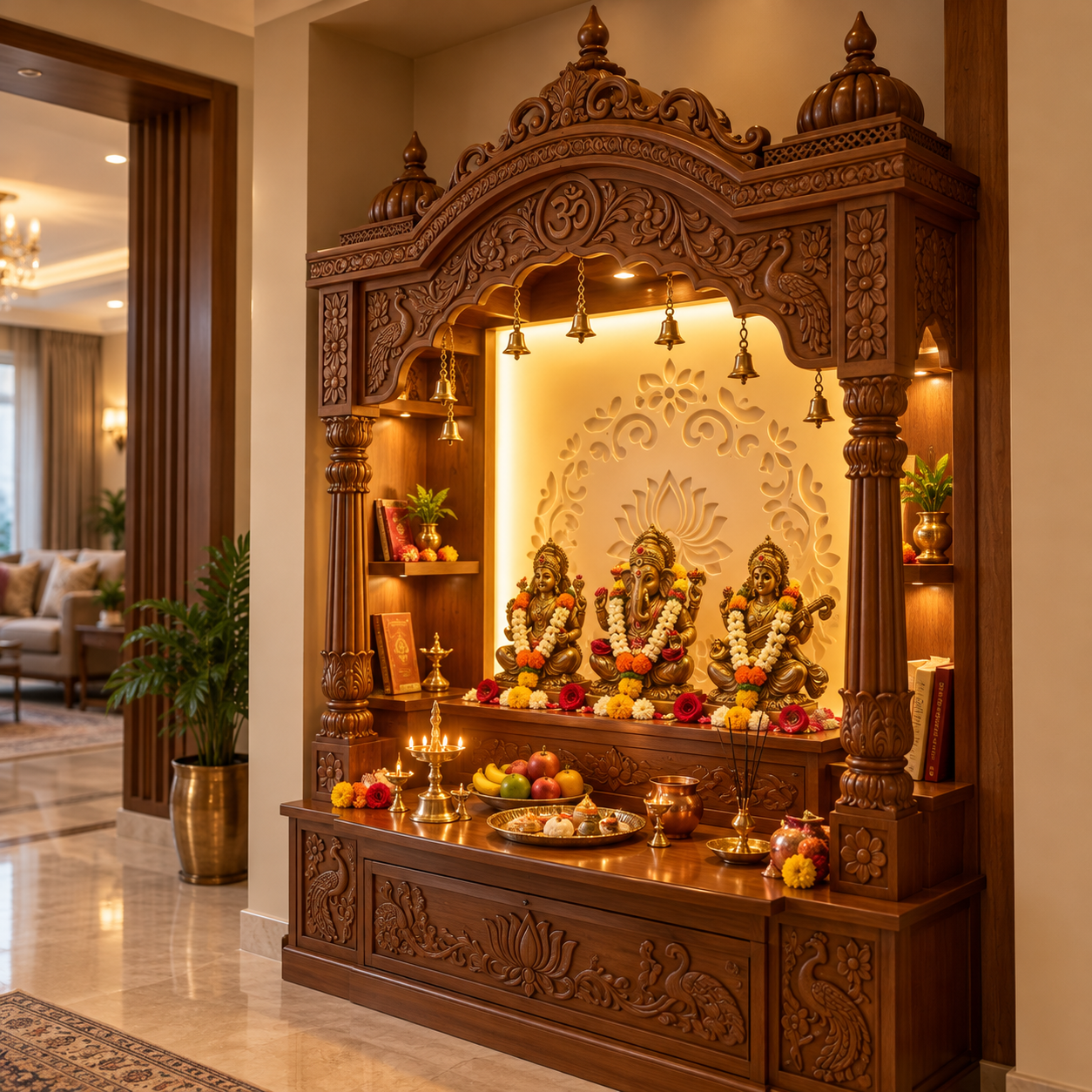
Vastu Shastra places the mandir in the northeast corner, the Ishanya kona, with the murti facing west or east so the worshipper faces east or north while praying. We follow that whenever the house allows it. What we add is the part the tradition does not cover: which wall will still be a good wall in ten years.
- Not under an HVAC supply register. Conditioned air blowing onto a shrine dries and cracks wood panels, warps book covers, and pushes dhoop and camphor soot straight across the marble. This is the single most common siting mistake we correct.
- Not under a stair, and not sharing a wall with a bathroom. Both are traditionally avoided, and both are also physically poor: footfall vibration above, and plumbing noise plus moisture behind.
- Not in an unconditioned basement. Beyond tradition, a DMV basement swings well past 60 percent relative humidity in July, which is where books warp and mold.
- Check the floor, not just the wall. Marble weighs roughly 170 pounds per cubic foot, so a 3 cm chowki plus a stone shikhara can put 600 to 1,200 pounds on a four-square-foot footprint. The IRC assumes 40 pounds per square foot of live load in a living area. We orient the base to span several joists, and add blocking or sister a joist when the layout concentrates the load.
- Leave 36 inches in front. That is one person on an asan with room to bow; 42 inches if two people sit. Measure this before choosing a cabinet depth, the same discipline we use on small-space layouts.
Three Formats That Fit DMV Homes
Nearly every mandir we build is one of three things. Depth is what decides which one you can have, and it is the number worth settling first.
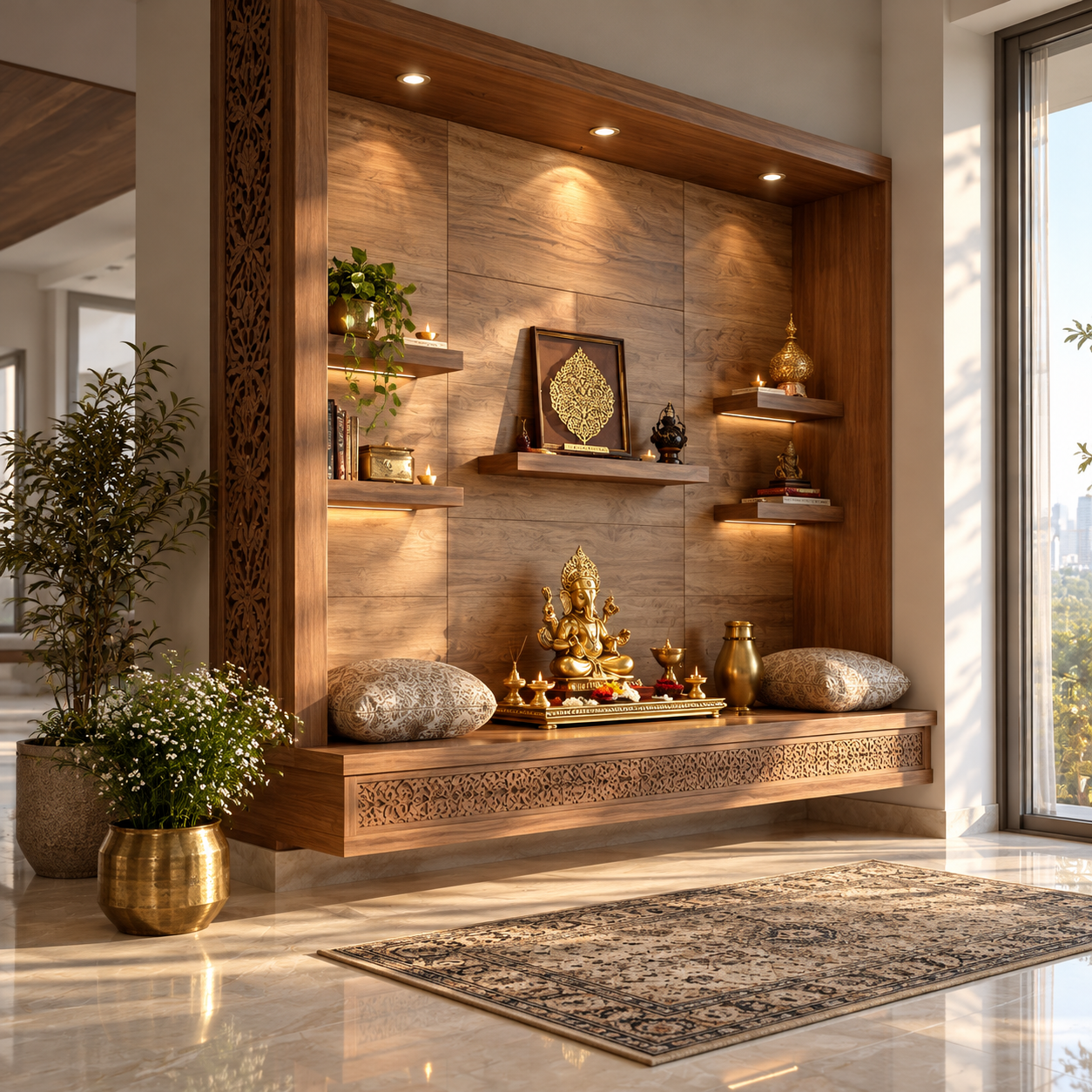
- Recessed niche. Framed into a 2x4 wall with a shallow bump-out to reach a usable 14 to 18 inches. Perfect for a dining or living room wall where no floor space is available. Below about 16 inches deep you cannot fit a marble chowki and a seated murti together, so the bump-out is usually not optional.
- Closet conversion. A reach-in closet already gives you 24 to 30 inches of depth, a header, and a door opening. Converting it is the best value per dollar of anything on this list, and it is how most Bethesda and Chevy Chase condo mandirs get built. We handle the same conversion logic in reverse on custom closets.
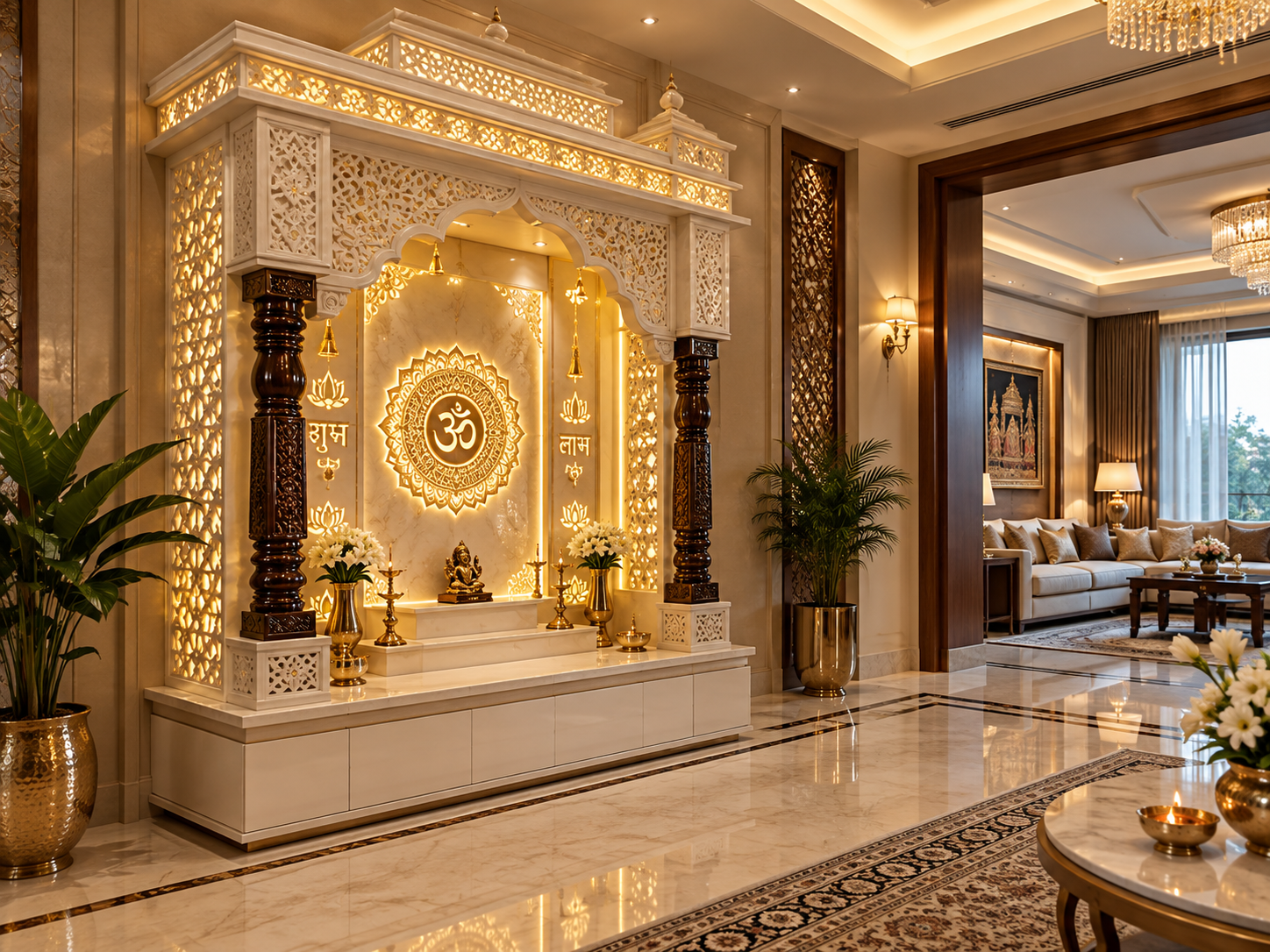
- Freestanding built-in. A full carcase that projects into the room, scribed to wall and ceiling so it reads as architecture. This is where carved teak or sheesham, a stone shikhara, and a brass jali belong. It is also the format that eats walkway, so we draw the plan before we draw the elevation.
Mandir Materials: Marble, Wood, Brass
A mandir is the one cabinet in the house that routinely meets open flame, hot ghee, milk, water, turmeric, kumkum, lemon, and camphor soot. Material choices that are fine in a kitchen are not automatically fine here.
| Material | Where it belongs | What to know |
|---|---|---|
| Makrana, Vietnam white, Carrara, Thassos marble | Chowki deck, shikhara, jali surrounds | Reads as traditional and stays cool under a diya, but it is calcareous. Specify honed, not polished: etch marks from lemon or vinegar are close to invisible on a honed surface. |
| Granite or quartzite | Abhishek deck, prakshal pan surround | Acid resistant and the right answer where milk, water, and juice land daily. See quartz vs. granite. |
| Engineered quartz | Not under a flame | Its resin binder scorches and yellows with sustained heat and direct sun. Fine on a lower drawer top, wrong directly beneath a lit diya. |
| Teak, sheesham, sandalwood accents | Carved traditional casework, pillars, torana | Dense, stable, and the woods that hold fine carving detail longest. The traditional choice, the most expensive, and the one with import paperwork attached. |
| White oak, maple, cherry | Contemporary casework paired with a marble deck | Domestic, well priced, and takes a catalyzed finish that wipes clean of soot film. Our usual recommendation for a modern mandir. |
| Brass and copper | Jali screens, bell mount, inlay, abhishek trays | Decide lacquered or unlacquered up front: unlacquered patinas and can be polished, lacquered stays bright but the lacquer fails if you polish it. |
| Painted MDF | Budget niches only, away from water | It swells permanently once abhishek water finds an edge. We will build it, but not under a prakshal pan. |
The high-grade stones and woods we specify
A mandir is small enough that the premium material is affordable, and visible enough that it is worth it. These are the grades we source, and what each one is actually for.
- Makrana marble. The world-famous, high-purity calcitic white marble extracted from the mines of Makrana in Rajasthan, India. It is the stone of the Taj Mahal and the Victoria Memorial, and in 2019 it became the first stone from Asia designated a Global Heritage Stone Resource by the International Union of Geological Sciences. For a mandir, what matters is the behavior behind the reputation: a dense, tight calcitic grain that takes deep jali carving without crumbling at the edges, and a warm white that does not yellow with age the way many resin-filled white marbles do. It is our default for a carved chowki, a shikhara, or pierced jali panels.
- Vietnam white marble. A high-purity, hard crystalline natural stone known for its brilliant white base, sparkling crystal structure, and minimal or soft veining. It is the right call when you want an unbroken, even white with no grey movement running through the murti backdrop, and its hardness makes it the more forgiving choice for a large flat deck that takes daily use. It typically prices below Makrana for comparable brightness.
- Carrara, Statuario, and Thassos. The Italian and Greek whites. Statuario for dramatic grey veining, Thassos for the brightest near-pure white available, Carrara for a soft grey-white at the most accessible price. All three are calcareous and behave like Makrana around acids.
- Sandalwood. A class of heavy, fine-grained, and fragrant yellow-brown woods from trees belonging to the genus Santalum. Indian sandalwood (Santalum album) holds its fragrance in the heartwood for decades, which is exactly why it belongs in a mandir and exactly why it is scarce. India restricts felling and export, so we use it the way it should be used: a carved murti, an inlaid medallion, a door panel, a bead of trim, in legally sourced and documented plantation material. Anyone offering you a full sandalwood mandir carcase at a normal price is not selling you sandalwood.
- Burma teak (Tectona grandis). High natural oil content gives it dimensional stability and rot and insect resistance that no finish can add. It is the most stable wood you can put next to a lamp and a water tray, and it ages to a deep honey rather than going grey.
- Sheesham, or Indian rosewood (Dalbergia sissoo). Dense, deeply figured, and the wood that holds the crispest carving detail of anything on this list. One thing to know before you import one: the entire Dalbergia genus has been listed on CITES Appendix II since January 2017, and the listing reaches finished furniture, not just lumber. A carved sheesham mandir shipped from India needs real CITES documentation. Ask for the permit, not an assurance, and ask recently, because the annotations get revised at each Conference of the Parties.
- Brass, copper, and bell metal. For jali screens, the bell and its mount, inlay lines, and abhishek trays. Bell metal (kansa) is the traditional alloy for a ghanti and it rings noticeably longer than a cast brass bell.
- Semi-precious inlay. Mother-of-pearl, malachite, lapis, and carnelian set into white marble is the parchin kari technique used on the Taj Mahal. On a home mandir it is usually one medallion or a border, and it is the single detail that most reliably makes a shrine look commissioned rather than bought.
Two material details that matter in Maryland
Marble and acid. The Natural Stone Institute is direct about it: products containing lemon, vinegar, or other acids may dull or etch calcareous stones, and the sealers used in the trade are impregnators that make stone more stain resistant rather than stain proof. A mandir deck sees exactly those substances every week, which is why we hone the marble and we do not sell sealing as protection.
Wood and our humidity. Interior wood tracks indoor relative humidity, and the USDA Forest Products Laboratory puts the equilibrium moisture content of wood at 70°F anywhere from 4.5 percent to 16 percent across a 20 to 80 percent humidity range. A DMV house swings from dry winter heating to a humid August, so solid-wood doors and panels have to be built as frame-and-panel with floating panels. A glued-up slab door on a mandir will crack, and it will crack at the carving.
Puja Cabinets: Diyas Low, Books High
The puja cabinet is where a built mandir earns its cost. Everything a family uses for puja has a natural height, and getting the order right solves fire safety, book preservation, and daily convenience at the same time.
The best place to store diyas, ghee, and camphor
A deep lower drawer, lined with a removable stainless or brass tray. Four reasons, in order of how often they come up:
- Spills stay in a pan. Ghee and oil creep. A removable metal liner means a spill is a five-minute cleanup rather than a permanent stain on the carcase bottom.
- Fuel sits below the flame. Storing a ghee tin or a camphor box on a shelf above a burning diya puts the fuel in the heat plume. Below is the right side of that geometry.
- Weight goes low. A full drawer of brass diyas is heavy. Low drawers on full-extension undermount slides carry it without racking the box.
- The lit diya gets its own clear zone. NFPA's candle guidance is to keep an open flame at least 12 inches from anything that can burn, in a sturdy holder that will not tip, and it notes that over half of home candle fires start because something combustible was too close. A mandir with an akhand jyot or a nightly diya needs that 12 inches designed in, which is why we set the chowki deck at 34 inches with 28 inches of open, non-combustible height above it, rather than tucking the flame under a 14-inch shelf.
The best place to store scripture and puja books
A closed compartment at the top, on an interior wall, away from any vent. The Bhagavad Gita, Ramcharitmanas, Sundarkand paath, a Pratikraman or a Navkar book, stuti and aarti collections: these are paper, and paper has requirements. The Library of Congress recommends keeping books in a cool environment at about 70°F or below with relative humidity between 30 and 55 percent, away from vents and radiators, shelved upright with similar sizes together, and specifically warns off basements and attics because of poor humidity control and flood risk.
Translated into cabinetry, that means four things. The book compartment goes high, where soot and ghee splash do not reach. It gets doors, because dust and camphor film are both abrasive. It never shares a drawer with oil or ghee, because vapor migrates and stains paper. And if the family wraps scripture in cloth, which most do, specify unbleached cotton rather than a plastic sleeve, which traps moisture against the binding. Placing books above shoulder height is also what tradition asks for: scripture does not go on the floor.
Between those two ends sit the shallow drawers for the thali, bell, panchpatra, chandan bowl, kalash, agarbatti stand, and puja cloth. Twelve inches of drawer bank at waist height handles all of it, and it is the one zone families consistently under-size when they buy a mandir instead of building one.
Hindu and Jain Mandir Construction
Maryland has both communities in strength, and the DMV supports them well, with Sri Siva Vishnu Temple in Lanham and Shri Mangal Mandir in Silver Spring on one side and the Jain Society of Metropolitan Washington in Silver Spring on the other. We build for families from all of them, and the design brief genuinely differs. Asking which tradition the mandir serves is our first question, not a courtesy.
Hindu home mandir: what changes the build
- Multiple murtis, one hierarchy. Most households place several deities plus framed photographs of elders. We design a tiered chowki so the primary murti is highest and centered, which avoids the crowded single shelf that boxed mandirs force.
- Abhishek for a Shiva lingam. Daily water or milk abhishek needs real drainage. We detail a sloped stone or stainless pan with a removable catch vessel underneath. Plumbing it to a drain is possible but rarely worth the permit and the wall opening.
- Aarti needs swing room. A thali circling in front of the murti needs clear width and no low-hanging shelf. We size the open zone to the family's actual thali.
- The bell has a correct height. Mounted so it is rung at standing shoulder height, on blocking, not on a cabinet back panel that will drum.
- Doors for shayan. Shutters that close fully at night, with no gap at the stiles. In a tight room we use pocket or bifold leaves so an open door does not block the aisle.
Jain gruh mandir and ghar derasar: what changes the build
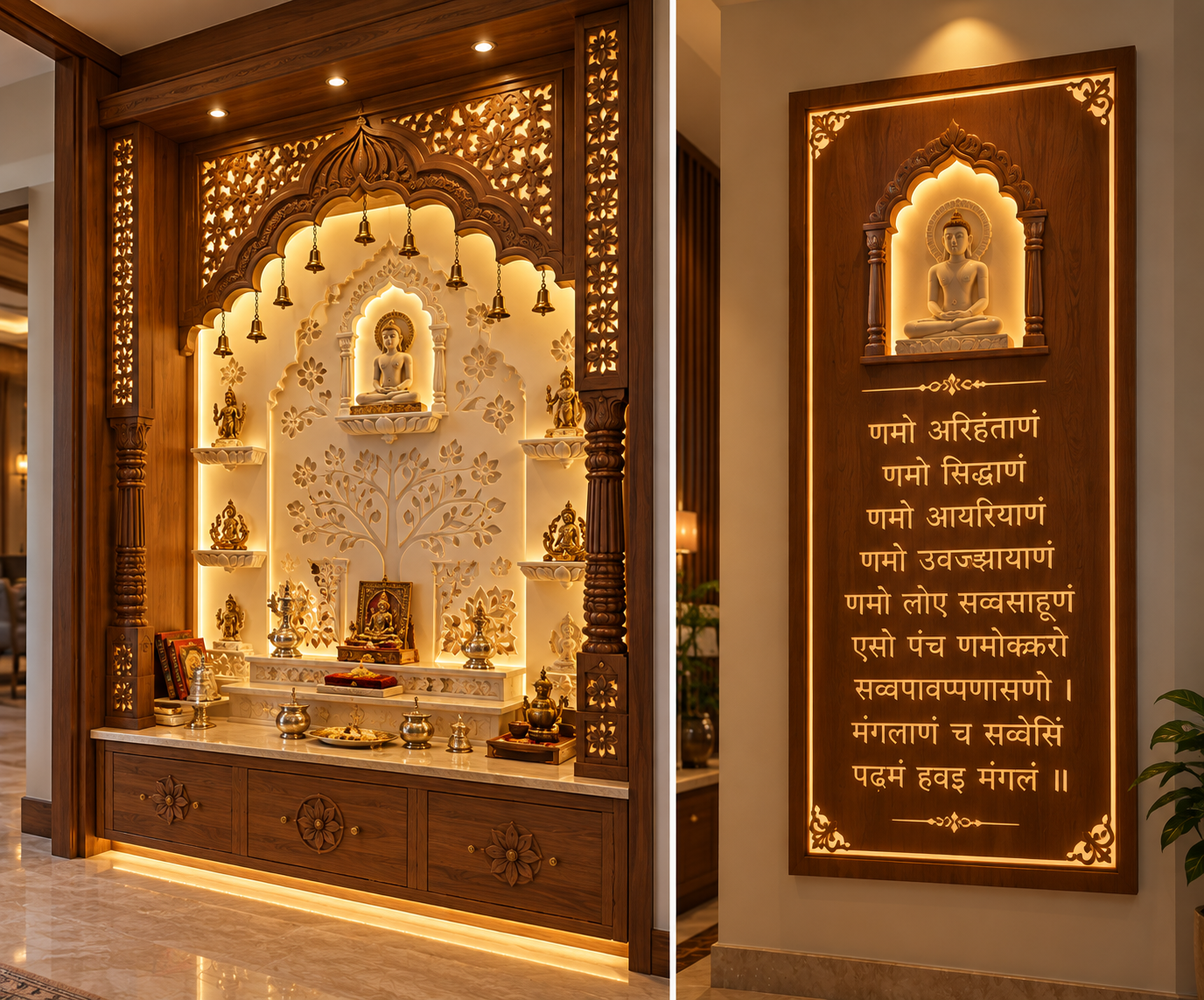
- Prakshal is daily, so water is a design problem, not an accident. For a Murtipujak or Deravasi family, the pratima of a Tirthankara is bathed every morning. That makes the sloped pan, the removable catch basin, and an acid-tolerant stone deck mandatory rather than optional, and it rules painted MDF out entirely.
- Ashtaprakari puja needs eight small stations. Jal, chandan, pushpa, dhoop, deepak, akshat, naivedya, and phal all want their own vessel within arm's reach of a seated worshipper. We lay out a shallow upper drawer with fitted dividers instead of one deep bin.
- The shrine closes completely. Full-height doors that seal, because the pratima is covered outside puja hours, and because purity means dust does not settle on it.
- Purity extends to the materials list. No leather anywhere near the shrine, which rules out some upholstered kneelers and bench tops, and we keep the finish schedule to coatings that cure fully and do not off-gas into a space used at dawn.
- An engraved mantra panel is often the better second piece. A backlit Navkar Mantra carved into hardwood, or a Siddhachakra in marble, gives the shrine a companion wall without crowding the pratima. We cut these on our own machines and hand-finish the letterforms, which matters: machine-cut Devanagari with no hand relief reads flat and wrong up close.
- Aniconic households need a different object entirely. Sthanakvasi and Terapanthi families generally do not use a murti. The brief becomes a quiet, enclosed samayik space: a clean seat, a closed shelf for Pratikraman books and a mala, a place for a muhpatti, and often a Navkar mantra or Siddhachakra plaque rather than an altar. It is a simpler build and it is a different build, and a vendor who only sells carved mandirs will try to sell you the wrong one.
One thing both traditions share and both are poorly served on: smoke. Dhoop, agarbatti, and camphor deposit a fine, oily film that yellows lacquer, hazes glass doors, and greys white marble. A mandir in a dead-air closet will show it within a year. We either keep the shrine in a space with real air movement or add quiet, dampered exhaust, and we specify a catalyzed finish that can be wiped. That work ties into lighting and drywall on most projects.
What a Custom Home Mandir Costs in Maryland
| Scope | What is included | 2026 DMV range |
|---|---|---|
| Recessed niche mandir | Framed niche, hardwood casework, honed marble chowki, LED lighting, two drawers | $4,500 to $9,000 |
| Closet conversion | Closet demo, full casework, closing doors, marble deck, dedicated circuit, book and fuel storage | $8,000 to $18,000 |
| Freestanding custom built-in | Carved teak or sheesham, marble or stone shikhara, brass jali, integrated lighting, abhishek pan | $15,000 to $35,000 |
| Dedicated puja room | Stone floor and wall cladding, full millwork, ventilation, electrical, door and trim package | $35,000 and up |
These are planning ranges for scoping a project, not quotes. What moves them most: carving hours, marble thickness and whether a shikhara is stone or wood, how many drawers are fitted with dividers, whether an abhishek pan is draining or catching, and whether new circuits are involved. Adding circuits, dedicated lighting, or an exhaust fan requires an electrical or mechanical permit from the Montgomery County Department of Permitting Services, and framing a niche into a load-bearing wall requires a building permit. Hire a contractor with an active Maryland Home Improvement Commission (MHIC) license; we pull the permits on every project.
Want a number for your wall?
Send us the wall and the room, and we will tell you which of the three formats fits and what it costs. Call (301) 881-1115 or request a free design consultation.
Where We Build Home Mandirs
We work from our North Bethesda showroom across Montgomery County, Howard County, and the wider DMV. The mandirs we have built cluster in the communities with the largest South Asian populations in the region:
- Howard County: Ellicott City, Columbia, Clarksville, Fulton, and Elkridge, where larger colonials and new builds usually have the depth for a freestanding built-in or a dedicated puja room.
- Montgomery County: Potomac, Bethesda, Chevy Chase, North Bethesda, Rockville, North Potomac, Darnestown, Clarksburg, Germantown, Gaithersburg, Olney, and Silver Spring. Potomac and Clarksburg tend toward full puja rooms; Bethesda and Chevy Chase condos tend toward niches and closet conversions.
- Nearby: Northern Virginia and Washington, DC, where older row house masonry walls change the framing approach, as they do on our DC built-in projects.
Browse related work: interior design, carpentry services, countertops, and the brands we carry. Choosing finishes to sit beside a marble chowki? Our guides to countertop materials and building a color palette both apply.
Frequently Asked Questions
Who builds custom home mandirs in Maryland?
iDesign Interior Solutions designs and builds custom home mandirs across Maryland from our North Bethesda showroom. We have designed and built over a dozen home mandirs in the Maryland area over the last five years, for families in Ellicott City, Potomac, Bethesda, Chevy Chase, Rockville, Clarksburg, Columbia, and Silver Spring. The work is carpentry and stone, not furniture assembly: framed niches, closet conversions, marble chowkis, brass jali, closing doors, and dedicated lighting and ventilation.
What is the best material for a home mandir?
Most Maryland mandirs we build pair a marble chowki with hardwood casework. Makrana marble, the high-purity calcitic white marble from Rajasthan used on the Taj Mahal, is the traditional benchmark and takes deep jali carving without crumbling; Vietnam white marble is a hard, brilliantly white crystalline alternative with minimal veining for an even murti backdrop. All white marbles are calcareous, so acidic puja items etch a polished surface and a honed finish hides it. For wood, Burma teak is the most stable near a lamp, sheesham holds the crispest carving but carries CITES paperwork on import, and sandalwood belongs in carved accents and inlay rather than casework. Granite or quartzite is the better choice for the abhishek deck because it shrugs off acid, and engineered quartz is the one surface to keep away from a lit diya because its resin binder can scorch and yellow.
Where should the mandir be placed in the house?
Vastu Shastra names the northeast corner, with the murti facing west or east so the worshipper faces east or north. The building has opinions too: pick a dry, quiet interior wall, away from an HVAC supply register, not under a stair, not sharing a wall with a bathroom, and not in an unconditioned basement. In most DMV homes the traditional answer and the practical answer land on the same wall.
Where is the best place to store diyas and puja books?
Keep them apart and at opposite ends of the cabinet. Diyas, ghee, oil, wicks, and camphor belong in a deep lower drawer with a removable metal or stainless tray liner: the weight sits low, spills are contained, and the fuel is below the flame. Scripture and puja books belong high, in a closed compartment above the soot plume and ghee splash, on an interior wall away from vents. The Library of Congress recommends storing books at about 70 degrees Fahrenheit or below and 30 to 55 percent relative humidity, away from radiators and vents, which also rules out a basement or attic shrine.
How much does a custom home mandir cost in Maryland?
For 2026 in the DMV, a recessed niche mandir with hardwood casework and a marble chowki typically runs about $4,500 to $9,000. A closet conversion with closing doors, lighting, and stone generally runs about $8,000 to $18,000. A freestanding custom built-in with carved hardwood, a marble shikhara, and integrated lighting usually runs about $15,000 to $35,000, and a dedicated puja room with stone walls and floor, millwork, ventilation, and electrical typically starts around $35,000. These are planning ranges, not quotes.
Do I need a permit to build a home mandir in Montgomery County?
Cabinetry and stone installed in an existing room generally do not require a building permit, but adding circuits, dedicated lighting, or an exhaust fan does require an electrical or mechanical permit through the Montgomery County Department of Permitting Services, and framing a new niche into a load-bearing wall requires a building permit. Confirm with your jurisdiction, and use a contractor holding an active Maryland Home Improvement Commission (MHIC) license.
Can you build a Jain gruh mandir as well as a Hindu mandir?
Yes. We build both, and the differences are real rather than cosmetic. A Jain gruh mandir for a Murtipujak family needs daily prakshal, so the chowki is detailed around a sloped stone or stainless pan with a removable catch basin, and the doors have to close fully. A Sthanakvasi or Terapanthi household usually wants no murti at all, so the design becomes a clean, enclosed samayik space with a shelf for Pratikraman books and a mala, and a seat rather than an altar. Hindu mandirs more often need an abhishek drain for a Shiva lingam, a bell at the right height, and room for an aarti thali to swing.
Sources and Further Reading
- • Natural Stone Institute — Care and Cleaning of Natural Stone — the source for the marble guidance above: acidic products dull or etch calcareous stones, abrasive scouring creams scratch, and stone “sealers” are impregnators that increase stain resistance rather than making stone stain proof.
- • Library of Congress — Preserving Your Books: Storing Your Books — the temperature and humidity targets we design the scripture compartment around, roughly 70°F or below at 30 to 55 percent relative humidity, away from vents and radiators, and the specific warning against basement and attic storage.
- • National Fire Protection Association — Candle Safety Tip Sheet — the 12-inch open-flame clearance, the sturdy non-tipping holder on an uncluttered surface, and the finding that over half of home candle fires begin because something combustible was too close.
- • CITES — Appendices I, II and III — the official listing behind the sheesham note: the whole Dalbergia genus sits in Appendix II, the hash annotations define which parts and derivatives count as regulated specimens, and the lists are revised at each Conference of the Parties, so check the current version rather than a remembered one.
- • USDA Forest Products Laboratory — Wood Handbook, Chapter 4: Moisture Relations and Physical Properties of Wood — the equilibrium moisture content figures behind the frame-and-panel recommendation: 4.5 to 16 percent EMC at 70°F across a 20 to 80 percent relative humidity range.
Ready to design your home mandir?
Book a free design consultation. We measure the wall, check the floor framing and the airflow, ask which tradition the mandir serves, and hand you a dimensioned elevation and an itemized quote. Visit our North Bethesda showroom to see marble, hardwood, and brass samples side by side. Serving Ellicott City, Potomac, Bethesda, Chevy Chase, Columbia, Rockville, Clarksburg, Silver Spring, and the greater DMV.