Quick summary
Quartz and granite are the two materials Maryland homeowners ask us about most during a kitchen remodel. Both are durable and both land in overlapping price ranges, so the decision usually comes down to two things: how much heat your cooking puts on the counter, and whether you want a pattern you can predict or a slab nobody else has. Granite handles heat better and may need periodic sealing. Quartz gives you controlled color with no routine sealing, but resin scorches. Below is per-square-foot pricing, the installed line items that actually move the number, how to tell the two apart, black-and-white quartz design notes, and the Maryland permitting and licensing details worth confirming before you sign.
Table of contents
- Quartz vs. granite at a glance
- Price per square foot
- What changes the installed price
- Which is more heat resistant?
- Maintenance and sealing
- How to tell quartz from granite
- Black and white quartz countertops
- Which material looks more natural?
- What homeowners say on Reddit
- Silica and engineered quartz
- Maryland permits and licensing
- Questions to ask before you choose
- Frequently asked questions
Quartz and granite rank among the most popular countertop materials for Maryland kitchen remodeling projects. Both provide excellent durability, attractive design options, and long-term value, but they perform differently in heat resistance, maintenance, appearance, and price.
The right choice depends on how you cook, how much maintenance you accept, and whether you prefer a consistent design or a one-of-a-kind natural stone slab. At iDesign Interior Solutions we encourage homeowners to compare the complete installed project rather than choosing a surface based only on a small showroom sample or an advertised price per square foot. If you want the wider field first — quartzite, marble, soapstone, butcher block, concrete, and laminate alongside these two — start with our complete kitchen countertop materials guide and come back here to settle the finalists.
Quartz vs. Granite Countertops at a Glance
| Feature | Quartz countertops | Granite countertops |
|---|---|---|
| Material | Engineered mineral surface with binders and pigments | Natural stone cut from a quarried slab |
| Appearance | Controlled colors and repeatable patterns | Unique colors, crystals, and movement |
| Sealing | Normally does not require sealing | May require periodic sealing |
| Stain resistance | Excellent when properly maintained | Very good when properly sealed |
| Heat resistance | Heat resistant, but vulnerable to high heat and thermal shock | More heat resistant, but trivets remain advisable |
| Pattern consistency | High | Low, because every slab is different |
| Typical price | Often comparable to granite | Often comparable to quartz |
| Best fit | Consistent design and minimal sealing | Natural character and stronger heat tolerance |
Neither material wins every category. Quartz often works well for homeowners who want predictable colors and limited routine maintenance. Granite often works well for homeowners who value natural variation, high heat resistance, and the experience of selecting a specific slab.
Quartz vs. Granite Price Per Square Foot
| Material | Installed Range (National Guides) |
|---|---|
| Quartz, standard colorsWidely stocked engineered colors, standard eased or bevel edge, straightforward layout. | $59 – $90 / sq ft |
| Quartz, premium and marble-look designsHeavy-veined or designer lines, mitered or waterfall detail, book-matched island panels. | $90 – $130+ / sq ft |
| Granite, stocked slabsLocally stocked colors at a Maryland slab yard, standard edge, no exotic movement. | $43 – $75 / sq ft |
| Granite, exotic and specialty slabsImported or rare stone, leathered or honed finish, dramatic movement requiring slab layout. | $75 – $140+ / sq ft |
| Countertops inside a full kitchen remodelSurface, backsplash, sink, and cabinet decisions quoted together rather than line by line. | Priced with cabinets and layout |
*These figures are rough planning estimates only. Your actual quote will depend on in-home measurements and the current cost of materials and labor at the time of your project, as well as the specific finishes and scope you choose. For an accurate price, schedule a free in-home consultation with our team.
These figures are planning benchmarks drawn from national installation guides, not a proposal. A lower-cost granite can come in under a premium quartz design, and a readily available quartz color can come in under an exotic granite slab.
What Changes the Installed Countertop Price?
The final cost of quartz or granite countertops includes more than the surface itself. Ask whether your estimate includes:
- • Digital field measurement and templating
- • Slab material and the number of slabs required
- • Fabrication, sink and cooktop cutouts, and edge finishing
- • Removal and disposal of the existing countertops
- • Backsplash fabrication and seam placement
- • Island overhang supports and waterfall panels
- • Plumbing disconnection and reconnection
- • Delivery, stair carries, or elevator coordination
This matters in Maryland because housing conditions vary so much. Carrying a large fabricated section into a Baltimore rowhouse is a different job than installing the same material in an open suburban home in Potomac or North Bethesda. Condos around the Pike District and Grosvenor may require elevator reservations, certificates of insurance, and restricted delivery hours. Older homes in Annapolis, Takoma Park, Kensington, and Chevy Chase frequently have walls and cabinets that are not perfectly square, which is exactly why templating happens after the cabinets are set rather than before.
Accurate templating and thoughtful seam placement protect the finished appearance and prevent expensive installation problems. In a compact galley or rowhouse kitchen, seam placement can also decide whether the counter reads as one continuous surface — one of several reasons our small kitchen layout guide treats the countertop and the layout as one decision.
Is Quartz or Granite More Heat Resistant?
Granite provides stronger heat resistance than engineered quartz. The Natural Stone Institute reports that granite is typically heat resistant to approximately 480°F. It still discourages placing concentrated heat directly on the stone, because rapid temperature differences create thermal stress and possible cracking.
Quartz countertops contain mineral particles, pigments, and binding resins. High heat can scorch or discolor the resin and may cause permanent damage. Caesarstone advises homeowners not to place pots or pans directly from an oven or stovetop onto quartz, and recommends trivets.
Choose granite when
- • You cook frequently with cast-iron pans
- • You regularly move cookware straight from the oven to the counter
- • You want more protection against accidental heat exposure
- • You prefer natural stone next to the range or cooktop
Choose quartz when
- • You consistently use trivets and hot pads
- • You prioritize a controlled color and pattern
- • You want a surface that does not require routine sealing
- • You accept that heat protection has to become a daily habit
We recommend trivets on both materials. Granite handles heat better, but protecting any countertop preserves the surface, the sealer, the seams, and the cabinetry underneath.
Quartz vs. Granite Maintenance
Quartz maintenance
Quartz offers straightforward daily care because the engineered surface is nonporous. Most quartz countertops do not require sealing. Clean with a soft cloth, mild dish soap, and water, and follow the specific care instructions from the manufacturer, since approved products vary by brand.
Avoid:
- • Hot pans placed directly on the surface
- • Abrasive scouring pads
- • Harsh or highly concentrated chemicals
- • Cutting directly on the countertop
- • Prolonged exposure to products that may discolor the resin
Quartz resists many common household spills, but no countertop is completely stain-proof or damage-proof.
Granite maintenance
Granite is a natural stone with absorption rates that vary slab to slab. A quality fabricator can determine whether the stone you selected needs an impregnating sealer. Clean it with a pH-neutral stone cleaner or mild soap and water, and avoid acidic or abrasive products that can degrade the sealer or the finish.
Granite maintenance may include periodic resealing, but do not assume every countertop needs sealing on a fixed annual schedule. The stone type, the original treatment, your cleaning habits, and sealer quality all change the timeline. If low-maintenance and low-VOC finishes are a priority throughout the house, our eco-friendly design guide covers sealers, adhesives, and recycled-content surfaces in more detail.
Quartz vs. Granite Countertops: How to Tell the Difference
Homeowners often search for quartz vs. granite countertops how to tell, usually after moving into a house with no record of what was installed. A few visual clues do most of the work.
Granite usually has natural irregularity
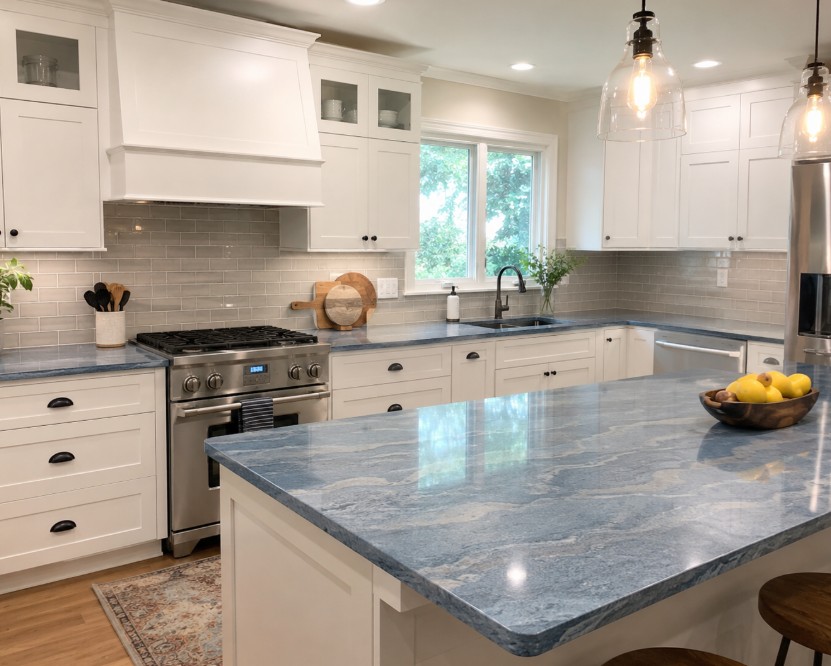
Granite often contains visible mineral crystals, small pits, color changes, and unpredictable movement. The pattern does not repeat in a controlled way, because nature formed the slab. Two pieces cut from the same slab coordinate, but they will never look identical.
Quartz usually looks more controlled
Quartz commonly has a more consistent background color and a pattern created during manufacturing. Some designs include recognizable repeated veins or evenly spaced movement. Modern quartz imitates marble and granite convincingly, so appearance alone does not always give a definite answer.
Check an unfinished area
The underside of a countertop, the edge near the dishwasher, or an unfinished cutout usually reveals the material structure. Quartz shows a fairly uniform composite. Granite shows natural crystals throughout. A fabricator or remodeling contractor can give you the most reliable identification when the visual clues stay ambiguous.
Do not confuse quartz with quartzite. Quartz is an engineered countertop material. Quartzite is a natural stone with different fabrication, maintenance, and pricing characteristics. Our countertop materials guide breaks quartzite out as its own category for exactly this reason.
Black and White Quartz Countertops
Black and white quartz gives Maryland homeowners two dramatically different design directions.
White quartz countertops
White quartz stays popular because it reflects light and reads clean. It makes a compact galley or rowhouse kitchen feel brighter and more open, which matters in the north-facing kitchens common in older DMV houses. It works particularly well with natural wood cabinets, navy or green islands, white shaker doors, warm brass hardware, black fixtures, and full-height quartz backsplashes.
Pure white surfaces show coffee, cooking residue, and metal marks faster than patterned designs. A softly veined white quartz gives you visual interest while making everyday marks less obvious. If you are still working out how the counter relates to cabinet and wall color, our guide to choosing a color palette covers how DMV daylight shifts white and gray tones through the day.
Black quartz countertops
Black quartz creates contrast and anchors a large island or a contemporary kitchen. It pairs well with white oak, walnut, cream cabinets, and lighter flooring. It hides certain food stains, but a polished dark surface reveals dust, fingerprints, soap residue, and hard-water marks. Maryland homes on mineral-heavy water usually need more frequent wiping around the sink, which is worth knowing before you commit to a high-gloss black.
Before choosing black quartz, view a full slab and a large sample under both natural and artificial light, and check it against your lighting plan. Small samples do not show final pattern, reflectivity, or cleaning behavior accurately.
Which Material Looks More Natural?
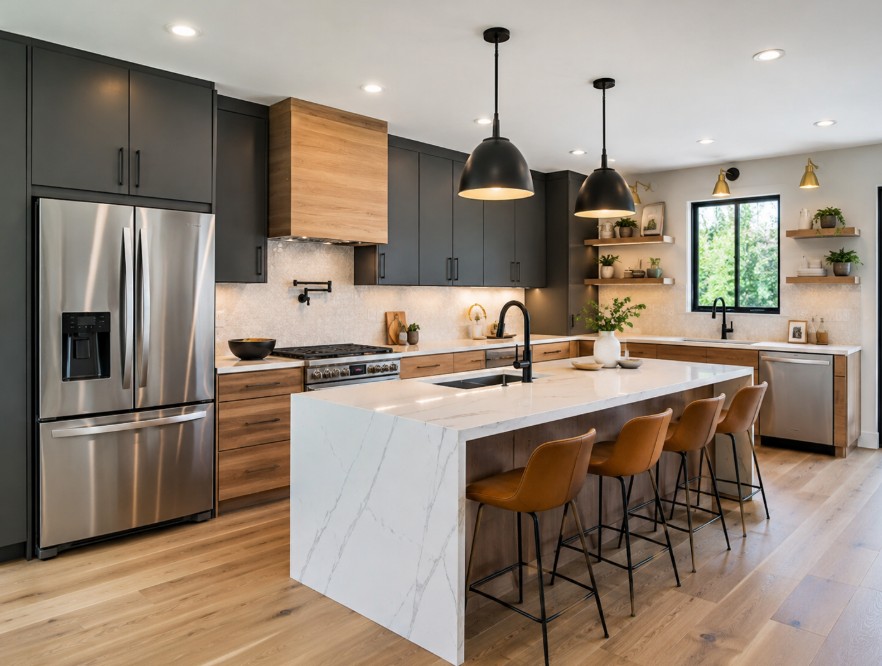
Granite offers authentic geological depth. Each slab has its own combination of crystals, veining, movement, and color. Quartz offers control: manufacturers can produce soft white backgrounds, dramatic veining, concrete-inspired finishes, and nearly solid black surfaces with far more predictability.
Granite suits a kitchen where the countertop is the main design feature. Quartz suits a kitchen where cabinetry, lighting, tile, and architectural details should carry the visual weight — the same reasoning that shapes an open floor plan, where the counter is visible from the living space and has to coexist with the furniture. Our open concept living guide covers that sightline problem in detail.
When you are considering granite, select the actual slab rather than relying on a sample. Photograph it, confirm which sections land on the island and which on the perimeter, and discuss seam placement before fabrication begins.
You can compare stocked quartz and granite side by side at our North Bethesda showroom before visiting a slab yard. iDesign is an authorized dealer for the major engineered-surface lines — Cambria, Caesarstone, Cosentino (Silestone and Dekton), and MSI Surfaces — alongside natural stone, so you can hold a full-size sample of each finalist in the same light instead of judging quartz from a two-inch chip and granite from a photo. We keep hundreds of free samples on hand to take home.
What Does Reddit Recommend: Quartz or Granite?
A frequently discussed r/kitchenremodel poll asked, “Help me choose please: Granite or quartz? What’s everyone choosing?” It drew 54 votes: 38 for quartz and 16 for granite, or about 70 percent for quartz. The discussion underneath was considerably more divided than the poll result alone.
Quartz supporters commonly mentioned:
- • Controlled colors and less visual movement
- • No routine sealing
- • Easy coordination with cabinets and backsplashes
- • A cleaner, more contemporary appearance
Granite supporters commonly mentioned:
- • Greater heat tolerance
- • Natural patterns that never repeat
- • Attractive slabs that sometimes cost less than premium quartz
- • The experience of picking a unique piece of stone at a slab yard
Commenters repeatedly advised viewing full slabs before deciding, and several participants changed their initial preference after comparing quartz samples against natural granite in person. Reddit reveals real homeowner experience, but it does not replace product specifications, professional measurements, or manufacturer care instructions. Quartz quality varies by manufacturer, and granite performance varies by stone type and fabrication quality.
What About Silica and Engineered Quartz?
That same Reddit discussion raised concerns about respirable crystalline silica. Silica exposure primarily affects workers who cut, grind, drill, or polish stone products and generate fine airborne dust, and OSHA requires employers performing that work to follow applicable exposure-control standards.
An intact countertop does not create fabrication dust during normal kitchen use. Homeowners should still ask how a fabricator protects employees and the home during any on-site modification. Look for:
- • Most cutting completed at a controlled fabrication facility
- • Wet-cutting methods where appropriate
- • Local dust collection and HEPA equipment
- • No uncontrolled dry cutting inside the home
- • Documented compliance with OSHA silica-control requirements
Granite and other natural stones release silica-containing dust during fabrication too. Safe cutting practices matter for engineered and natural stone alike.
This is one of the practical reasons to confirm licensing before you hire. iDesign Interior Solutions is a licensed and insured Maryland home improvement contractor and a licensed kitchen countertop installer working across Montgomery County and the wider DMV, and we are glad to share our license details and references at your consultation. Ask any contractor you are considering to do the same, and to walk you through where the cutting happens and how dust is controlled on site.
Maryland Remodeling and Permit Considerations
Replacing countertops without structural changes may not require a building permit in some Maryland jurisdictions. Montgomery County, for example, states that installing countertops does not require a residential alteration permit when the work involves no structural change.
A larger kitchen remodel may require permits when the project includes:
- • Removing or modifying walls
- • Changing structural framing
- • Moving plumbing or gas lines
- • Adding or relocating electrical circuits
- • Changing windows or exterior doors
- • Creating a new layout that affects regulated building systems
Permit requirements differ among Maryland counties and municipalities — in Montgomery and Prince George's counties, plumbing permits come from WSSC Water rather than the county, a detail that surprises most homeowners. Confirm requirements with your local permitting department before construction begins. Maryland also requires home improvement contractors who contract with homeowners to hold the appropriate Maryland Home Improvement Commission license; verify it, and make sure the written agreement identifies the project scope clearly. We walk through the same permitting path in detail in our Bethesda tub to shower conversion guide, which is a useful reference for how Montgomery County handles a fixture-level remodel.
Questions to Ask Before Choosing Quartz or Granite
Before approving a countertop selection, ask your kitchen remodeling contractor or fabricator:
- Does the quote include fabrication and installation?
- How many slabs will the kitchen require?
- Where will the seams appear?
- Does the price include sink and cooktop cutouts?
- Will the island overhang require added support?
- Does this specific granite require sealing, and how often?
- Which cleaning products does the quartz manufacturer approve?
- How should I protect the surface from heat?
- Can I view the full granite slab or the full quartz design?
- Does the project require plumbing, electrical, or building permits?
Those ten questions produce a far more useful comparison than material price alone.
Quartz or Granite: Which One Should You Choose?
Quartz may be the better fit when you want:
- • A consistent color or veining pattern
- • White, black, or controlled neutral tones
- • No routine sealing
- • Easy coordination across a large kitchen
- • A modern or transitional appearance
Granite may be the better fit when you want:
- • A unique natural slab
- • Stronger resistance to high heat
- • Natural crystals, depth, and movement
- • A surface that becomes the kitchen's focal point
- • Access to an attractive locally stocked slab at a competitive price
For most Maryland homeowners the decision comes down to appearance and daily habits. Quartz reduces uncertainty during design. Granite provides stronger natural character and heat performance. Compare full slabs, request a complete installed estimate, and select the material that supports the way you actually use your kitchen.
Frequently Asked Questions
Is quartz or granite cheaper in Maryland?
Neither material is reliably cheaper. Current national installation guides put quartz at roughly $59 to $130 per square foot installed and granite at roughly $43 to $140 per square foot installed, so the ranges overlap almost completely. A stocked granite color can come in under a premium quartz design, and a readily available quartz can come in under an exotic granite slab. The installed total matters more than the material: templating, fabrication, cutouts, edge profile, seams, island support, and old-countertop removal can move a Maryland kitchen by several thousand dollars on identical square footage.
Which is more heat resistant, quartz or granite?
Granite. The Natural Stone Institute puts granite’s heat resistance at roughly 480°F, while engineered quartz contains resins and pigments that can scorch or discolor permanently. Caesarstone specifically advises against setting pots or pans straight from the oven or cooktop onto quartz. Use trivets on both surfaces anyway: granite tolerates heat better, but rapid temperature change can still cause thermal stress in natural stone.
Does granite need to be sealed every year?
Not necessarily. Absorption varies by stone, and a good fabricator can test the specific slab. Some dense granites need sealing rarely; more porous stones need it more often. The stone type, the original treatment, your cleaning products, and the quality of the sealer all change the interval, so ask your fabricator about your slab rather than following a fixed annual schedule.
How can I tell if my existing countertop is quartz or granite?
Look for natural irregularity. Granite shows visible mineral crystals, small pits, and movement that never repeats; two pieces from the same slab coordinate but are not identical. Quartz usually has a more consistent background and a manufactured pattern that can repeat. Because modern quartz imitates stone convincingly, check an unfinished area such as the underside, the edge near the dishwasher, or a cutout, where granite shows crystals throughout and quartz looks like a uniform composite. A fabricator can confirm it in person.
Do I need a permit to replace countertops in Maryland?
Often no. Montgomery County, for example, states that installing countertops does not require a residential alteration permit when there is no structural change. Permits come into play once the project moves walls, alters framing, relocates plumbing or gas, adds or moves electrical circuits, or changes the kitchen layout in a way that affects regulated systems. Requirements differ by county and municipality, so confirm with your local permitting office before work starts. Maryland also requires the contractor to hold an active Maryland Home Improvement Commission license.
Is black or white quartz better for a Maryland kitchen?
It depends on light and upkeep. White quartz brightens compact galley and rowhouse kitchens and pairs well with natural wood, navy or green islands, and brass hardware, but pure white shows coffee and metal marks quickly — a softly veined white hides daily use better. Black quartz anchors a large island and works with white oak, walnut, and cream cabinets, but polished dark surfaces reveal dust, fingerprints, and hard-water spotting, which matters in Maryland homes on mineral-heavy water. View a full slab in both natural and artificial light before deciding.
Plan Your Maryland Kitchen Remodel With iDesign Interior Solutions
Countertops affect nearly every other kitchen decision: cabinet color, backsplash height, sink selection, lighting, hardware, and appliance placement. iDesign Interior Solutions helps Maryland homeowners build coordinated kitchens that balance appearance, durability, function, and budget, and our process considers the entire room rather than treating the countertop as an isolated purchase.
We are a licensed kitchen countertop installer serving Bethesda, North Bethesda, Rockville, Chevy Chase, Potomac, Silver Spring, and the greater DMV, and an authorized dealer for the countertop brands we install, including Cambria, Caesarstone, Cosentino, and MSI Surfaces. That means one accountable team from slab selection through templating, fabrication, and installation, rather than a material order handed off to a subcontractor you never meet.
Start with our countertop installation page for fabrication and edge options, our kitchen design page for the full remodel scope, or our cabinet refacing page if new counters on existing boxes is the project you have in mind.
Further Research
Ready to compare quartz and granite in person?
Book a free in-home consultation with a licensed countertop installer. We measure the kitchen, review how you cook, walk you through stocked quartz and granite at our North Bethesda showroom as an authorized dealer for every line we carry, and hand you an itemized quote that includes templating, fabrication, cutouts, and installation. Related pages: brands we carry, countertops, custom cabinets, and kitchen design.
Request your free consultation