Quick summary
Countertops drive the look, the maintenance, and a large share of the budget of any kitchen remodel. This guide compares the nine materials we install most often, including quartz, granite, quartzite, marble, soapstone, butcher block, solid surface, concrete, and laminate. We cite the Natural Stone Institute and Consumer Reports countertop testing so the recommendations match independent data. The closing section covers practical tradeoffs for Bethesda and DMV kitchens, including humidity, hard water, and resale expectations.
Table of contents
How to Choose a Countertop Material
Rank five criteria before you look at samples: budget, heat resistance, stain resistance, maintenance, and the look you want. No single material wins every category. If sustainability matters to you, our eco-friendly design guide covers recycled-content and FSC-certified options.
The Natural Stone Institute publishes care and use guides that explain how each stone behaves under real kitchen conditions. See the Natural Stone Institute care guides before you fall in love with a slab.
Consumer Reports tests countertop materials against heat, stains, scratches, and impact under controlled conditions. Browse the Consumer Reports countertop ratings for current rankings.
Quartz (Engineered Stone)
Quartz mixes roughly 90 percent ground stone with resin and pigment. It does not need sealing, resists most stains, and comes in consistent patterns from slab to slab.
The resin softens under direct heat. Always use a trivet under a hot pan. Quartz scratches under aggressive cutting, so use a board.
Best for: busy households that want low maintenance and a predictable look.
Watch out for: heat damage and discoloration under sustained sunlight near a south-facing window.
Granite
Granite is a natural igneous stone, very hard, and highly heat resistant. Each slab is one of a kind.
Granite needs a penetrating sealer at installation and again every one to three years depending on the stone. A water bead test on the surface tells you when to reseal.
Best for: cooks who set hot pans on the counter and want a natural look.
Watch out for: dark coffee, red wine, and oil on unsealed granite.
Quartz and granite are the two finalists in most of the kitchens we quote, and the choice between them turns on heat, sealing, and how predictable you want the pattern. Our quartz vs. granite comparison for Maryland kitchens goes deeper on price per square foot, heat limits, and local permitting.
Quartzite
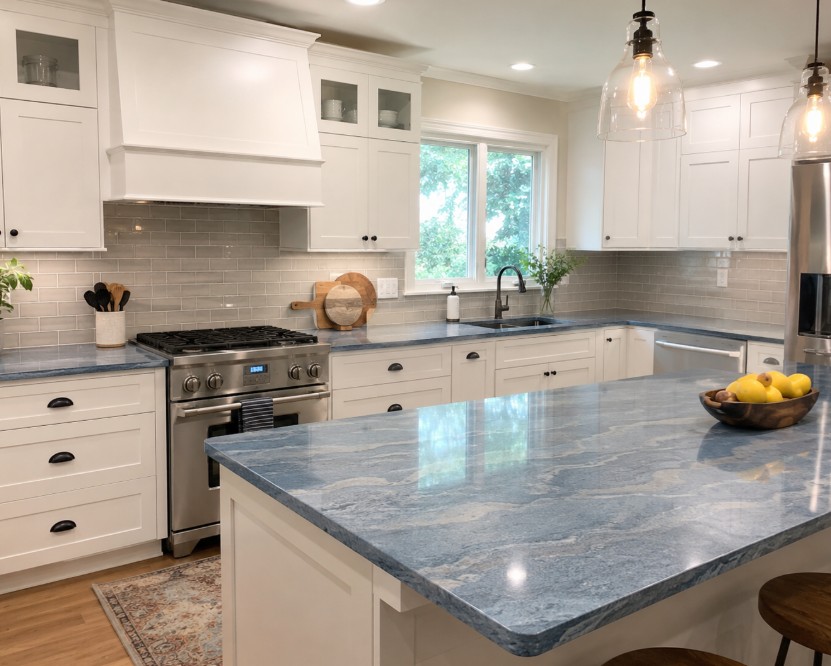
Quartzite is a natural metamorphic stone that often looks like marble but performs closer to granite. It resists scratches and heat better than marble.
True quartzite is harder than glass. Some slabs sold as quartzite are actually softer dolomitic marble. Ask the supplier for a hardness test before you commit.
Best for: the marble look without marble fragility.
Watch out for: mislabeled slabs and acid etching on softer stones marketed as quartzite.
Marble
Marble is a softer natural stone with classic veining. Lemon juice, vinegar, wine, and tomato sauce etch the polished surface within seconds.
A honed finish hides etching better than a polished finish. Marble bakers love it for pastry work because it stays cool.
Best for: pastry stations, butler's pantries, and bathrooms.
Watch out for: daily kitchen use if you cannot live with patina.
Soapstone
Soapstone is a quartz-free natural stone with a soft, matte feel. It does not stain because it is non-porous, and acids do not etch it.
It scratches more easily than granite, but light scratches sand out. Many owners oil the surface monthly to deepen the color.
Best for: historic homes, farmhouse kitchens, and anyone who hates sealing.
Watch out for: the limited color palette, mostly gray to dark charcoal with green undertones.
Butcher Block
Butcher block is solid wood, usually maple, walnut, or cherry. It warms the look of a kitchen and gives you a built-in cutting surface.
Wood needs sealing with food-safe oil or a hard finish. Keep it dry near the sink. Cracks form when water sits in the joints for weeks.
Best for: islands, prep stations, and accents next to a stone main run.
Watch out for: water damage around the sink and dishwasher.
Solid Surface
Solid surface materials such as Corian are acrylic-based and seamless. Sinks integrate directly into the counter, which makes cleanup easy.
Light scratches and scorches sand out. Hot pans melt the surface, so it is not the choice for serious cooks.
Best for: bathrooms, laundry rooms, and accessibility-focused kitchens.
Watch out for: heat damage and a plastic feel under task lighting.
Concrete
Concrete countertops are cast in custom shapes and pigmented to any color. They feel industrial and read warm.
Concrete is porous and needs both a penetrating sealer and a topical wax. Hairline cracks are normal as the slab cures and the house settles.
Best for: modern kitchens with custom edge profiles.
Watch out for: staining around the sink and the weight, which often needs cabinet reinforcement.
Laminate
Laminate is the budget choice. Modern patterns mimic stone and wood at a fraction of the cost. Installation is fast.
Laminate scratches, burns, and lifts at the seams. Water that sits at the backsplash joint swells the particleboard core within a season.
Best for: rental units, short-term kitchens, and basement bars. Landlords weighing durability against cost for a turnover often lean on a property management company to set finish standards that survive tenant turnover.
Watch out for: water at seams and a thin look on undermount sink cutouts.
Side-by-Side Comparison
| Material | Typical cost (installed) | Heat | Stains | Sealing |
|---|---|---|---|---|
| Quartz | $$ - $$ | Fair | Excellent | Never |
| Granite | $$ - $$ | Excellent | Good (sealed) | 1-3 years |
| Quartzite | $$ - $$$ | Excellent | Good (sealed) | 1-2 years |
| Marble | $$ - $$$ | Excellent | Poor | 6-12 months |
| Soapstone | $$ - $$ | Excellent | Excellent | Oil monthly |
| Butcher block | $ - $$ | Poor | Fair | Oil monthly |
| Solid surface | $ - $$ | Poor | Excellent | Never |
| Concrete | $$ - $$ | Excellent | Fair | Yearly |
| Laminate | $ - $ | Poor | Fair | Never |
Cost tiers are relative and assume professional installation in the Bethesda and DMV market. Always confirm pricing with a fabricator using the actual slab.
DMV-Specific Notes
Bethesda, Potomac, and Chevy Chase tap water runs hard. Hard water leaves visible mineral spots on dark granite and polished marble around the faucet. A honed finish hides spots better than a polished one.
Summer humidity in the DMV is high. Wood and concrete counters move more here than in dry climates. Plan expansion gaps and seal the end grain on butcher block.
Resale matters across the DMV. Quartz and granite are the safest choices for buyers in most price points. Marble reads luxury but turns off some buyers who fear etching.
Local fabricators stock most stone slabs in warehouses in Beltsville, Capitol Heights, and Springfield. Visit the warehouse and pick your slab in person. Two slabs of the same stone can vary in pattern by a wide margin.
Mistakes to Avoid
- • Picking a slab from a small sample without seeing the full piece
- • Choosing marble for a primary kitchen when you cook with citrus and tomato every day
- • Installing butcher block right next to a dishwasher without a sealed end
- • Skipping the seam plan, then ending up with a seam in the middle of the sink cutout
- • Forgetting to specify edge profile, overhang, and backsplash height in the contract
- • Buying laminate to save money on a kitchen you plan to sell within five years
When a Designer Pays for Itself
Countertop choices interact with cabinet color, hardware finish, backsplash, and lighting. A designer narrows the field to two or three materials that fit the kitchen and the household, then walks you through the slab yard. If you're working with a compact footprint, our small kitchen layout guide pairs well with these material choices.
iDesign Interior Solutions has installed every material in this guide across Bethesda, North Bethesda, Rockville, Potomac, and the wider DMV. We match the material to the cook, the budget, and the look.
Ready to pick the right countertop?
Book a free design consultation and we will review your cooking habits, your kitchen finishes, and your budget before recommending materials. Want a ballpark first? Try our kitchen remodel cost calculator.
Request your free consultation