Quick summary
Most bathrooms that look dated at fifteen years are not worn out — they were built in a way that guaranteed a short life. Durable modern design is a set of specific, checkable decisions: a bonded waterproofing membrane instead of plain backer board, floor tile with a wet DCOF of at least 0.42, an exhaust fan that meets ASHRAE 62.2 and actually vents outside, non-porous counters, solid-brass valves from a brand with a real parts pipeline, and blocking in the walls for hardware you have not bought yet. None of it shows in a photo. All of it decides whether your bathroom remodel still looks and works well in 2045.
Table of contents
- Why bathrooms fail early
- The layer that decides everything: waterproofing
- Choosing tile that lasts and does not get slick
- Ventilation is a durability feature
- Vanities, counters, and cabinetry that survive humidity
- Fixtures: what to spend on and what to skip
- Designing modern without designing a date stamp
- What DMV houses specifically need
- What a durable bathroom costs here
- The spec checklist to hand your contractor
- Frequently asked questions
Why Bathrooms Fail Early
We open up bathrooms every week across Bethesda, Rockville, and Chevy Chase, and the failures are monotonous. Loose surround tile with black backer board behind it. A subfloor that flexes because the tile was set over a single layer of plywood. An exhaust fan that has been quietly dumping warm, wet air into an attic for a decade. A cracked shower pan corner where a rubber liner was folded instead of properly detailed.
Almost none of those are material failures. They are assembly failures — decisions made in the four days between demolition and tile, when nobody is taking photos. That is the whole thesis of durable design: the money that buys longevity is spent early, on things you will never see again, and it is a small fraction of the budget.
The corollary is more encouraging. If the wet assembly is right, everything above it is cosmetic and cheap to change. Vanities, mirrors, lighting, hardware, and paint are a weekend. Tearing out a shower because water got behind it is a month and five figures.
The Layer That Decides Everything: Waterproofing
Cement backer board is not waterproof. It is water-resistant and stable when wet, which is a different claim, and a surprising number of homeowners assume it is the barrier. The barrier is a separate bonded membrane — a sheet product or a liquid-applied coating — installed over the board and carried continuously through the corners, over the curb, and down into the pan.
The spec to ask for by name is a membrane meeting ANSI A118.10, installed to the methods in the Tile Council of North America Handbook, which is the reference the tile industry itself writes and updates for installation assemblies. If a contractor cannot tell you which TCNA method their shower follows or which membrane they use, that is the most useful red flag you will get during the bidding process.
Two related details are worth insisting on. First, a 24-hour flood test of the finished pan before any tile goes down — one day now versus a ceiling repair later. Second, movement accommodation: soft joints of silicone rather than grout at every change of plane (wall-to-wall, wall-to-floor, and at the curb), because rigid grout in a corner that moves is a crack waiting for a winter.
On the floor under the tile. Tile cracks because the thing under it moves. In older DMV houses with 16-inch joist spacing and a single layer of subfloor, the fix is an added layer of plywood or an uncoupling membrane before tile. It costs a few hundred dollars at rough-in and it is the difference between grout lines that stay closed and a floor you re-do in year eight.
Choosing Tile That Lasts and Does Not Get Slick
Porcelain is the durable default. It is denser and less absorbent than ceramic, it takes traffic, and large-format porcelain in a soft stone or concrete look gives you the modern read without natural stone's sealing schedule. Natural marble and limestone are gorgeous and high-maintenance; use them where they will be admired more than they are scrubbed.
The number to look for on the spec sheet is DCOF — dynamic coefficient of friction. Under ANSI A137.1, the standard the TCNA references, tile for level interior floors that will be walked on when wet should test at a wet DCOF of 0.42 or higher. Matte and textured porcelains generally clear it comfortably; polished stone and high-gloss tile generally do not, which is why a beautiful polished floor is a bad idea directly outside a shower.
A few practical rules we apply on every shower enclosure we build:
- • Large-format tile on shower walls, smaller tile or mosaic in the pan — more grout lines means more grip exactly where you are standing wet.
- • Rectified porcelain if you want tight, modern grout lines, since only rectified tile is dimensionally consistent enough for them.
- • High-performance or epoxy grout in the shower; it resists staining and does not need sealing the way cement grout does.
- • Buy 10 to 15 percent overage and keep a box in the basement. Tile runs get discontinued, and a spare box turns a future repair into an afternoon.
- • A full-height niche framed between studs, waterproofed as part of the wall, with a sloped bottom so it drains.
Ventilation Is a Durability Feature
Nothing shortens a bathroom's life faster than trapped humidity. It lifts paint, swells cabinet boxes, corrodes hinges, and feeds mold in the wall cavity. And the fix is the cheapest line on the quote.
ASHRAE Standard 62.2, the residential ventilation standard that most modern residential codes draw from, calls for bathroom local exhaust of 50 cfm intermittent or 20 cfm continuous. Treat that as the minimum. For a bathroom with a large walk-in shower, we size up, and we care more about how the fan is installed than about its rating:
- • Smooth rigid duct rather than flex, sized to the fan's outlet, with the shortest run and fewest elbows possible. A 50 cfm fan strangled by 20 feet of crushed flex duct is not moving 50 cfm.
- • Terminated through the roof or wall to the outdoors, never into an attic or soffit cavity.
- • A humidity-sensing or timer switch, so the fan runs after the shower rather than only during it.
- • An insulated duct in unconditioned attic space, so warm wet air does not condense inside the pipe and drip back down.
If you are also replacing lighting while the ceiling is open, our lighting page covers wet-rated shower fixtures and the layered scheme that makes a small bathroom read larger.
Vanities, Counters, and Cabinetry That Survive Humidity
A bathroom vanity lives in a climate no kitchen cabinet has to endure. Particleboard boxes with a thin laminate skin swell at the toe kick within a few years of daily showers. Plywood boxes with a moisture- resistant finish do not. That single substrate choice matters more than the door style you agonize over.
For counters, engineered quartz is the practical winner in a bathroom: non-porous, no sealing, and indifferent to the toothpaste, mouthwash, and cosmetics that etch natural marble within a year. If you want to compare surfaces properly, our quartz vs. granite guide runs the numbers, and our countertops page covers fabrication and edge profiles.
Other choices that quietly buy years:
- • Wall-mounted (floating) vanities — no toe kick sitting in mop water, easier floor cleaning, and a modern look that has held for two decades. They need solid blocking in the wall, so decide before drywall.
- • Soft-close, corrosion-resistant hardware. Cheap hinges in a humid room seize and rust; good ones are a small upcharge on a part you touch every day.
- • Undermount sinks with a solid-surface top, which eliminates the caulk line that goes gray on drop-in sinks.
- • Semi-gloss or a purpose-made bathroom paint over a moisture-tolerant primer. Flat paint in a bathroom is a maintenance decision, not a design one.
If storage is the real problem, a custom vanity sized to the actual wall usually beats a stock unit plus a wasted six inches on each side.
Fixtures: What to Spend On and What to Skip
Spend on anything buried in a wall, and be relaxed about anything you can unscrew. The shower valve is the clearest example: it is a $200 to $600 part sitting behind finished tile, and replacing it later means demolition. Buy a pressure-balancing or thermostatic valve with a solid-brass body from a manufacturer that will still stock the cartridge in fifteen years. The trim on the outside can be changed in an afternoon when your taste moves on, so treat finish as a low-stakes decision.
On flow rates, the EPA's WaterSense program labels showerheads at 2.0 gpm or less — below the federal 2.5 gpm maximum — and requires them to pass spray-force and coverage testing rather than simply restricting flow. That last part is why a modern labeled head feels nothing like the weak low-flow fixtures of twenty years ago, and it matters in older DMV houses where a second shower running upstairs already strains the supply.
- • Blocking behind the tile for grab bars, whether or not you install them now. It is nearly free before the wall closes and expensive after.
- • A thermostatic valve if you have two heads or a body spray, since a pressure-balancing valve alone will not carry the volume.
- • A comfort-height toilet with a readily available flush mechanism — an exotic import means an exotic part hunt.
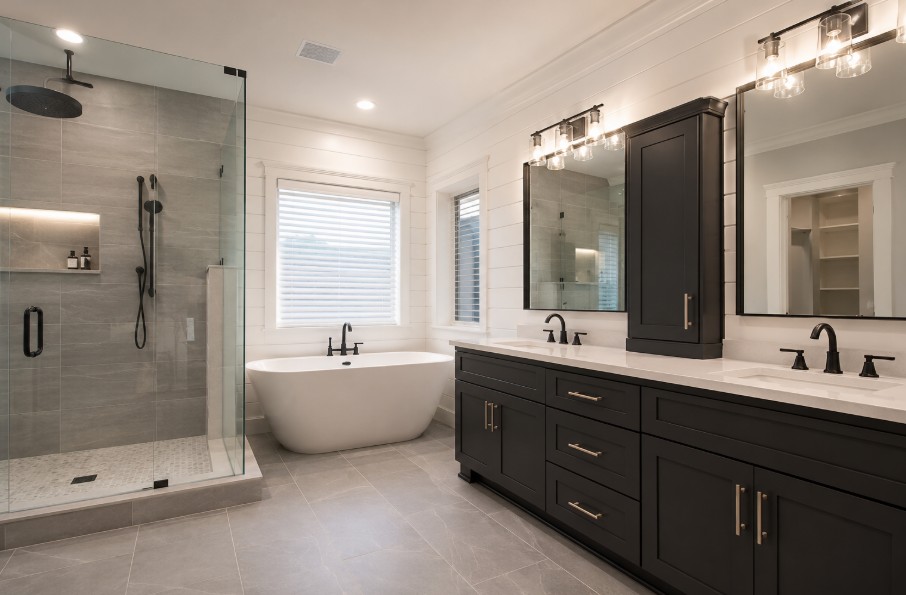
- • Heavy frameless glass with proper wall anchoring rather than a framed door, if the budget allows; it is the single upgrade that most changes how modern the room reads.
Designing Modern Without Designing a Date Stamp
Every era's bathroom trend eventually becomes its punchline: the avocado suite, the 1990s oak-and-brass combination, the all-gray 2015 flip. The way out is not to avoid style — it is to put the trend where it is cheap to remove.
Our working rule: permanent surfaces stay quiet, replaceable elements carry the personality. Floor tile, wall tile, and counters are ten-to-twenty-year decisions, so choose them for material quality and a restrained palette. Paint, mirrors, lighting, hardware, textiles, and the vanity face are three-to-seven-year decisions, so that is where the deep color, the unusual finish, and the strong shape belong.
Applied to the trends people ask us about most: a warm neutral large-format porcelain floor with a bold vanity color ages well. A bold patterned floor with a beige vanity ages badly, because the expensive half is the half that dates. If you want help pinning down the palette side of this, our color palette guide walks through it room by room, and our modern bathroom design ideas post covers the current styling directions.
What DMV Houses Specifically Need
The regional building stock changes the priorities. Here is what we actually find:
- • 1925–1965 colonials and capes (Bethesda, Chevy Chase, Silver Spring, Takoma Park): plaster walls, undersized 5-by-8 hall baths, galvanized supply lines that should be replaced while the wall is open, and second-floor joists that need stiffening before tile.
- • 1970s–80s split-levels (Rockville, Wheaton, Gaithersburg): original fiberglass units, fans vented into attics, and hollow-core doors that fail in humidity.
- • Pike District and Rockville condos: slab construction and shared plumbing stacks mean the drain generally cannot move and a truly curbless entry is rarely possible. Expect board approval and a contractor certificate of insurance before work starts.
- • Everywhere in the DMV: humid summers make ventilation a bigger factor than it is in drier climates, and Montgomery County plumbing permits come from WSSC Water rather than the county — a detail covered in our tub to shower conversion guide.
Whichever house you are in, the durability spend is the same short list. What changes is the repair work that has to happen behind the wall before any of it gets installed.
What a Durable Bathroom Costs in Bethesda and Rockville
| Project Scope | Estimated 2026 Cost* |
|---|---|
| Cosmetic refresh, existing layoutNew vanity, top, toilet, floor tile, lighting, paint, and fan. Wet walls stay in place. | $18,000 – $28,000 |
| Full gut, 5-by-8 hall bathDown to studs, membrane-waterproofed tub or shower, new supply and vent work, tile floor and walls. | $28,000 – $45,000 |
| Primary bath, tiled walk-in showerDouble vanity, heavy frameless glass, thermostatic valve, bench and niche, upgraded ventilation. | $45,000 – $85,000 |
| Curbless / aging-in-place primary bathRecessed floor structure, linear drain, 36-inch clear entry, grab-bar blocking throughout, comfort-height fixtures. | $55,000 – $110,000 |
| Durability upgrades within any scope aboveANSI A118.10 membrane, flood test, uncoupling or added subfloor, upsized ducted fan, blocking, brass valve bodies. | +5% – 8% of build |
*These figures are rough planning estimates only. Your actual quote will depend on in-home measurements and the current cost of materials and labor at the time of your project, as well as the specific finishes and scope you choose. For an accurate price, schedule a free in-home consultation with our team.
The Spec Checklist to Hand Your Contractor
Print this and put it in front of anyone bidding your bathroom. The answers tell you more about the bid than the price does.
| Ask about | The answer you want |
|---|---|
| Shower waterproofing | A named bonded membrane meeting ANSI A118.10, installed to a specific TCNA Handbook method. |
| Pan testing | A 24-hour flood test before tile, in writing on the schedule. |
| Floor tile slip rating | Wet DCOF of 0.42 or higher per ANSI A137.1, on the tile spec sheet. |
| Subfloor prep | Deflection checked; added plywood layer or uncoupling membrane where needed. |
| Ventilation | At least ASHRAE 62.2 airflow, rigid duct, insulated in attic, terminated outdoors, humidity or timer switch. |
| Valve | Solid-brass pressure-balancing or thermostatic body from a brand with long-term cartridge availability. |
| Blocking | Grab bars, bench, floating vanity, and towel hardware blocked before drywall. |
| Movement joints | Silicone, not grout, at every change of plane. |
| Vanity construction | Plywood box, moisture-resistant finish, soft-close corrosion-resistant hardware. |
| Permits | Who pulls them, and whether the plumbing permit path through WSSC Water is accounted for in the schedule. |
Cost figures are 2026 Bethesda-area planning estimates. Your quote depends on in-home measurements, the condition found behind existing tile, and the finishes you select.
Frequently Asked Questions
What makes a modern bathroom durable rather than just good-looking?
Durability lives in the layers you cannot see once the tile is up: a bonded waterproofing membrane that meets ANSI A118.10, blocking in the walls for grab bars and future hardware, a properly sized and ducted exhaust fan, and a valve from a brand whose cartridges will still be sold in fifteen years. Finishes matter far less than assembly. A $30-per-square-foot tile over an unwaterproofed wall fails faster than a $4 porcelain over a correctly built one.
Which bathroom floor tile is safest when wet?
Look for the dynamic coefficient of friction (DCOF) on the tile spec sheet. Under the ANSI A137.1 standard referenced by the Tile Council of North America, tile installed on level interior floors expected to be walked on when wet should have a wet DCOF of at least 0.42. Most matte and textured porcelains clear it easily; large polished stone and high-gloss tile usually do not. Smaller floor tile also means more grout lines, which adds grip in a shower pan.
How big should the exhaust fan be in a modern bathroom?
ASHRAE Standard 62.2 sets residential bathroom local exhaust at 50 cfm intermittent or 20 cfm continuous. That is a floor, not a target. For a bathroom with a steam-heavy walk-in shower, size up, duct it in smooth rigid pipe with as few elbows as possible, and terminate it outside the house rather than in the attic. A humidity-sensing or timer switch is the cheapest durability upgrade in the whole room.
Are quartz vanity tops better than marble in a bathroom?
For most families, yes. Engineered quartz is non-porous, needs no sealing, and shrugs off the toothpaste, mouthwash, and cosmetics that etch natural marble within a year. Marble is still the more beautiful surface and is fine in a powder room or a primary bath used by adults who will maintain it. If you want the marble look without the maintenance, a quartz with a soft veined pattern is the practical answer.
How much does a durable modern bathroom remodel cost in the DMV?
In Bethesda, North Bethesda, Rockville, and the surrounding Montgomery County market, a hall-bath refresh runs roughly $18,000 to $28,000, a full gut of a 5-by-8 hall bath runs about $28,000 to $45,000, and a primary suite with a tiled walk-in shower and frameless glass runs about $45,000 to $85,000. The durability upgrades in this article — membrane waterproofing, blocking, better ventilation, solid-brass valves — typically add 5 to 8 percent to the build, and they are the least expensive part of the job to do right the first time.
How long should a well-built bathroom last before it needs work again?
A correctly waterproofed and ventilated bathroom should go 20 to 30 years before anything structural needs attention. What dates it first is styling, not failure — a vanity, a mirror, lighting, and paint can be swapped in a weekend if the wet walls underneath were built properly. Bathrooms that fail early almost always fail for the same three reasons: no membrane, no ventilation, and movement in the floor under the tile.
Working With a Local Team on This
Durability is not a product you can buy at the showroom counter — it is a sequence of small decisions made correctly in the right order, most of them in the week nobody photographs. iDesign Interior Solutions has been building bathrooms across Bethesda, North Bethesda, Rockville, Chevy Chase, Potomac, Silver Spring, and the wider DMV for more than two decades, with over 2,700 completed projects. We spec the membrane, we flood test the pan, we duct the fan outside, and we block the walls for hardware you have not chosen yet.
You can see the finish options in person at our North Bethesda showroom in the Pike District — plan a visit to compare porcelain, quartz, glass thickness, and hardware finishes side by side in one trip.
Ready to build a bathroom that lasts?
Book a free in-home consultation. We measure the room, look at what is behind the existing tile, check the floor and the ventilation, and hand you a fixed itemized quote with the durability specs written into the scope. Related services: bathroom remodeling, shower enclosures, custom vanities, and bathtub installation.
Request your free consultation