Quick summary
A media wall is never built from one wood. The structure, meaning the boxes and the shelves, should be 3/4 inch hardwood plywood. The parts you see and touch, meaning face frames, doors, and exposed edges, are solid hardwood or MDF depending on whether the piece is getting painted or stained. For paint, use poplar or soft maple with MDF panels. For a natural finish, rift-sawn white oak is the safest modern choice, walnut is the premium one, and ash is the value one. Avoid raw particleboard and melamine on anything structural, and avoid wide solid wood panels anywhere, because seasonal humidity in the DMV moves them enough to crack the finish. Below: the full species comparison, shelf span limits, what changes in a basement or over a fireplace, and what each material actually costs on a custom entertainment center.
Table of contents
- The question is really two questions
- Sheet goods: plywood vs. MDF vs. particleboard
- Solid wood species, compared
- Paint-grade vs. stain-grade: how to decide
- Veneer, grain match, and why rift-sawn costs more
- Shelf spans: how far wood goes before it sags
- Fluted and slat media walls: real wood or MDF?
- Heat, humidity, fireplaces, and basements
- Finishes that survive a wall people touch
- What each material costs in 2026
- What we specify, by room
- Mistakes we see most often
- Frequently asked questions
The Question Is Really Two Questions
When someone asks what the best wood is for a media wall, they are usually picturing a species, walnut or white oak or maple. But almost no part of a well-built media wall is made of solid lumber. A cabinetmaker is answering two separate material questions at once, and they have different right answers.
The carcass question: what are the boxes, the shelves, the back panels, and the hidden structure made of? This is a sheet-goods decision, and it determines whether the piece stays square, holds screws, carries weight without sagging, and survives twenty years. Nobody sees it, and it is where quality is actually won or lost.
The show-surface question: what are the doors, drawer fronts, face frames, exposed edges, and visible shelves made of? This is the species and finish decision, and it determines what the room looks like.
A quote that answers only the second question is the one to be careful with. “Solid wood construction” in a sales conversation frequently means a solid wood face frame on a particleboard box. That is not dishonest on its face, but it is a materially different product from a plywood-cased build, and the price gap should reflect it.
Sheet Goods: Plywood vs. MDF vs. Particleboard
Three materials compete for the carcass, and they are not interchangeable.
Hardwood plywood — the right default
Three-quarter inch hardwood plywood, typically birch or maple faced, with a void-free core, is what a custom media wall should be built from. Cross-laminated plies make it dimensionally stable in both directions, so a 36 inch wide case stays 36 inches wide in February and in August. It holds a screw and a cam fastener properly, which matters for adjustable shelf pins and for anchoring the cabinet to the wall. It weighs roughly a third less than MDF of the same size, which is the difference between two installers lifting a tall case cleanly and three of them fighting it in a stairwell. And if a basement ever takes on an inch of water, plywood that dries out is usually still plywood.
Ask for the ply count and the core. A 9-ply or 13-ply domestic panel is a different product from a 5-ply import with a soft, voided core that telegraphs through the veneer and gives up its screws. For below-grade rooms, marine-grade or exterior-glue plywood is worth the small upcharge on the lower cases.
MDF — excellent in its place, bad everywhere else
Medium-density fiberboard is dead flat, perfectly consistent, and has no grain to telegraph through paint, which makes it the better material for painted door panels, applied moldings, routed profiles, and flat slab fronts. A painted MDF slab door is genuinely superior to a painted plywood one. It is also the correct substrate for most fluted and slat panels.
Where it fails: it is heavy, it holds screws poorly in edge grain, it sags under load across any meaningful span, and it swells permanently when wet and never recovers. MDF shelves in a media wall carrying a receiver, a console, and a speaker will develop a visible bow within a few years. Use moisture-resistant MDF, often sold green-tinted, anywhere near a basement slab or a bathroom-adjacent wall.
Particleboard and melamine — the line we do not cross
Melamine-faced particleboard is what most flat-pack and big-box entertainment units are made of. It is inexpensive, the surface is durable against scratching, and for a rental, a basement flex room, or a piece you expect to replace in five years it is a rational choice. It is not what a built-in should be, because it has the worst fastener holding of the three, it sags the soonest, the edges chip and cannot be repaired, and any water contact ends it. If a quote for a custom built-in is dramatically cheaper than the others, this is usually why. Our custom cabinets page explains how we build and finish casework across the whole house, and the same standard applies to a media wall.
Solid Wood Species, Compared
This is where the species question belongs: face frames, door stiles and rails, exposed edges, floating shelves, and applied trim. Hardness matters because a media wall gets handled constantly, at the doors, the drawer fronts, and the shelf edges. The Janka numbers below are the standard hardness measure, where higher means more dent resistance.
| Species | Janka | Relative cost | Best use on a media wall |
|---|---|---|---|
| Poplar | ~540 | $ | The paint-grade workhorse. Straight, stable, machines cleanly, takes primer and paint beautifully. Soft, so not ideal for a shelf edge that takes abuse. Never stain it. |
| Soft maple | ~950 | $ | The better paint-grade choice. Harder and denser than poplar, so door edges and shelf noses survive longer. Our default for painted media walls in family rooms. |
| Hard maple | ~1450 | $ | Very hard and pale. Excellent painted or with a clear coat. Blotches badly under stain unless conditioned, so do not plan on staining it a dark color. |
| White oak | ~1360 | $$ | The modern default. Hard, stable, and takes natural, white, and smoked finishes without turning orange. Rift-sawn gives the quiet straight grain that reads contemporary. |
| Red oak | ~1290 | $ | Durable and inexpensive, but the open cathedral grain and pink undertone read dated in most rooms. Fine if you are matching existing red oak trim or flooring. |
| Ash | ~1320 | $ | The value alternative to white oak. Similar hardness and tone, more active grain. Looks excellent in a light or white-washed finish on a contemporary wall. |
| Cherry | ~950 | $$ | Warm, fine-grained, and traditional. Darkens noticeably with age and light, which is a feature if you expect it and a surprise if you do not. Suits federal and colonial DMV homes. |
| Walnut | ~1010 | $$ | The premium choice and the warmest. Reads rich in low light, which is exactly what a media room is. Softer than oak, so pair it with careful detailing at edges. |
| Sapele / mahogany | ~1410 | $$ | Hard, stable, with a ribbon figure under quarter-sawing. A good walnut alternative when you want depth of color at a lower price. |
| Hickory | ~1820 | $$ | The hardest common cabinet wood, with dramatic color variation between boards. Great in a rustic or lodge room, visually loud in a minimal one. |
Janka figures are industry averages and vary by sample. Relative cost is for the species in cabinet-grade stock in the Mid-Atlantic market and moves with supply.
Paint-Grade vs. Stain-Grade: How to Decide
Choose paint-grade when the media wall should disappear into the architecture. In most DMV colonials, row houses, and condos, the trim is already painted. A painted media wall in the wall color, or a half-shade deeper, reads as original to the house and makes a small room feel larger. It is also repairable: a scuff is a touch-up, not a refinish. Poplar or soft maple face frames with MDF panels and a sprayed conversion varnish or waterborne lacquer is the build.
Choose stain-grade when the media wall is the room's one warm element. A natural wood wall in a modern condo or a contemporary renovation does the work of a rug and three textiles. It also performs better optically behind a screen, because mid-tone wood absorbs reflected light that a white painted wall bounces straight back at you. The cost goes into material selection and grain matching, not into labor hours, which is why the premium is real but bounded.
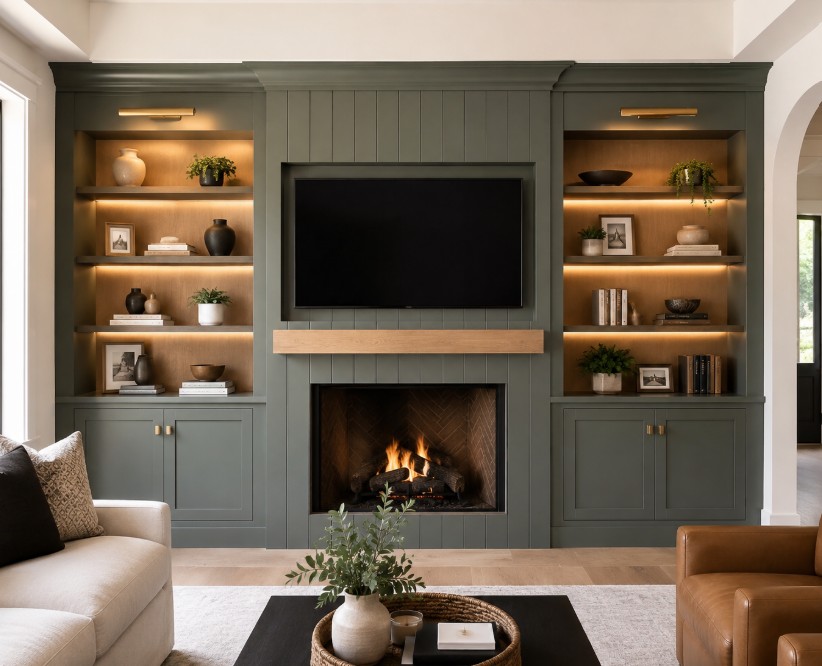
The hybrid is often the best answer. Painted base cabinets with a white oak or walnut upper shelf section and a wood-faced screen surround gives you the warmth at the eye level where it registers and the cost control everywhere else. It is the most common specification we write for a full-wall build. For how the color reads across the day in DMV light, our color palette guide covers the north-facing versus south-facing problem that decides it.
Veneer, Grain Match, and Why Rift-Sawn Costs More
Veneer has a reputation problem it does not deserve. The thin vinyl print glued to flat-pack furniture is not veneer in the cabinetmaking sense. Real wood veneer on a plywood or MDF core is a sheet of actual hardwood, and it is the correct, higher-performing way to build any panel wider than a few inches. It is dimensionally stable, it allows grain to run continuously across a wall of doors in a way solid lumber never could, and it uses the best material from a log across far more square footage.
How the log is cut determines the look and most of the price:
- • Plain-sawn gives the familiar cathedral arches. Cheapest, most visually busy, fine for traditional rooms.
- • Quarter-sawn gives straighter grain plus the medullary ray flecking that white oak is known for. More stable, more expensive.
- • Rift-sawn gives the tightest, straightest, quietest grain with no flecking. It is what makes a modern white oak media wall look calm instead of busy. It is also the most wasteful cut, which is why it costs the most.
Grain matching is a separate line item. Sequence-matched veneer, where adjacent doors continue each other's grain across the wall, requires buying sheets from the same flitch and laying them out together. On a wide media wall it is the single detail that most separates architectural millwork from assembled cabinetry, and it is the detail most often quietly dropped to hit a price. If it matters to you, specify it in writing.
Edge banding is where veneer jobs are judged. A thin iron-on tape eventually peels at the corners. A solid hardwood edge, typically 1/8 to 1/4 inch, glued on and sanded flush, is both tougher and invisible, and it lets the shelf edge take a hit. Ask which one you are getting.
Shelf Spans: How Far Wood Goes Before It Sags
Sagging shelves are the most common complaint about an otherwise good-looking media wall, and it is entirely a material and span problem. Working maximums for a shelf carrying real weight, meaning books, components, and speakers rather than a few frames:
- • 3/4 inch MDF: 24 to 28 inches. It will deflect visibly past that.
- • 3/4 inch hardwood plywood: about 32 inches.
- • 3/4 inch solid hardwood: 36 to 40 inches depending on species.
- • Any of the above with a 1 1/2 inch hardwood front edge: add roughly 25 to 40 percent to the span, because stiffness goes up with the cube of depth and the front edge is where the bending happens.
For spans beyond that, the honest options are a built-up shelf of 1 1/4 to 1 1/2 inch apparent thickness, a steel flat bar let into a groove in the underside, a center divider, or shorter bays. Long floating shelves, the kind that cantilever off the wall with no visible support, should be torsion boxes, meaning a hollow wood shell over an internal frame, mounted on a steel bracket set into the wall. A solid slab of lumber over 40 inches of cantilever will droop at the tip, and no finish hides it.
One more thing that gets missed: a shelf bows under sustained load over months, not under the load you test it with on install day. Size for the equipment you will own in five years.
Fluted and Slat Media Walls: Real Wood or MDF?
The vertical slat or fluted panel behind a television is the dominant media wall look right now, and it is built one of three ways at three very different prices.
Prefinished acoustic slat panels are widely available: thin wood veneer slats on a felt backing, sold in roughly 8 foot sheets. They install fast, they genuinely take some flutter out of the room, and they are the budget option. The weaknesses are that the felt reads as felt up close, the slat spacing is fixed so panel seams are hard to hide on a wide wall, and the veneer is thin enough that a damaged slat cannot be sanded.
Painted MDF flutes are the right answer for a painted wall. MDF machines into a crisp, perfectly repeating profile with no grain to telegraph, and painted in the wall color it produces the sculptural, architectural version of the look. It is also the most economical of the custom routes.
Solid hardwood slats on a plywood substrate are the premium build. Each slat is milled, finished, and spaced deliberately so the reveals land where the design wants them and the wall returns correctly at the ends and at the ceiling. You can mix slat widths, run them over a dark painted backer for depth, or stop them at a shelf line. This is the one that holds up to close inspection, and it costs several times what prefinished panels cost.
Whichever you choose, the detail that matters is what happens at the edges. A slat wall that dies into a corner with a cut slat and a caulk line looks cheap no matter what it is made of; one that returns around the end with a finished edge looks built.
Heat, Humidity, Fireplaces, and Basements
Wood selection in the DMV is partly a climate decision. Indoor relative humidity here swings from roughly 30 percent in a heated February house to 60 percent or more in an August basement. Wood moves with that, across its width, not along its length. A 24 inch wide solid panel can change close to a quarter inch across the year, which is enough to crack a painted joint, split a glued-up panel, or bind a door. This is the single best argument for veneered plywood on every wide surface, and it is why experienced cabinetmakers do not build wide solid panels into fixed millwork.
Over a fireplace, the species is not the safety variable; clearance is. Follow the fireplace manufacturer's clearance-to-combustibles table exactly, since it is the document an inspector and your insurer will reference, and use a non-combustible surround material, stone, porcelain slab, or tile over cement board, in the zone it specifies. Then plan for the slow problem: a fireplace wall cycles dry for months each winter, which opens joints in solid wood over years. Veneered plywood and MDF both tolerate that cycle better. And before you design a screen into a fireplace wall at all, read the viewing-height section of our entertainment center cost and design guide, because the mount height is usually the bigger regret.
In a basement, specify a plywood carcass, moisture-resistant MDF for any painted panels, a finished back and underside rather than raw material facing the foundation wall, and a recessed toe kick that keeps the cabinet bottom off the slab. Hold the room between 40 and 50 percent relative humidity with a dehumidifier, and let the millwork sit in the finished room for several days before installation so it acclimates before it is fastened in place. Nothing on that list is expensive; skipping any of it is.
Worth asking about: formaldehyde. Composite panels can off-gas, and a media wall is a large area of material in a room people sit in for hours. Specify CARB Phase 2 compliant or, better, NAUF (no added urea formaldehyde) plywood and MDF. The upcharge is small and most reputable suppliers stock it by default now. Our sustainable design guide covers the certifications worth paying attention to and the ones that are marketing.
Finishes That Survive a Wall People Touch
The best wood with the wrong finish fails first. A media wall is handled daily at the doors, the drawer pulls, and the shelf edges, and it sits in whatever light the room gets.
- • Sprayed conversion varnish or catalyzed lacquer is the standard for painted and clear-coated cabinetry. It cures hard, resists handling, and lays down far smoother than anything brushed. It is shop-applied, which is an argument for shop-built millwork over site-built.
- • Waterborne polyurethane is the low-odor option and stays clear rather than ambering, which matters on white paint and on pale woods like maple and ash.
- • Hardwax oil gives white oak and walnut that matte, in-the-wood look that photographs well. It is genuinely repairable in place, which is its real advantage, but it needs occasional re-oiling and it is less resistant to spills.
- • Sheen matters more than people expect. Matte and eggshell hide the inevitable wall imperfections and the screen's reflection. Semi-gloss and gloss on a large wall opposite a window will mirror the room and wash out the television.
- • Pre-cat lacquer on a dark stain over a soft wood shows every fingerprint. If you want dark, use a harder species or a lower sheen.
Media Wall Material Costs in the DMV in 2026
| Material Specification | Estimated 2026 Cost per Linear Foot* |
|---|---|
| Melamine / particleboard carcass, laminate frontsWhat most flat-pack and big-box units are. Appropriate for a rental or a short-term basement build, not for a permanent built-in. | $150 – $300 |
| Plywood carcass, MDF panels, poplar face frame, paintedThe paint-grade standard and the best value in the table. Sprayed finish, soft-close hardware, scribed to the wall. | $350 – $600 |
| Plywood carcass, soft maple face frame and doors, paintedHarder edges than poplar at the places that get handled. Our default for family rooms with kids. | $450 – $750 |
| Plain-sawn white oak or ash veneer and solid stock, clear finishNatural wood at the accessible end. More grain movement across the wall, which suits transitional rooms. | $600 – $950 |
| Rift-sawn white oak, sequence-matched veneerThe quiet, straight-grain modern look. Premium is in material selection and grain matching, not labor hours. | $850 – $1,400 |
| Walnut, sequence-matched veneer and solid stockThe warmest and the most expensive of the common species. Best in low-light media rooms where it reads richest. | $1,100 – $1,900 |
| Add-on: painted MDF fluted or slat panel sectionRouted or applied flutes on an MDF substrate, sprayed. The economical route to the slat-wall look. | $90 – $200 |
| Add-on: solid hardwood slat wall on plywood substrateMilled and finished slats with deliberate reveals and finished returns at the ends and ceiling. | $250 – $500 |
| Add-on: integrated LED shelf lighting on a dimmerLow-voltage strip in the shelf reveals with the driver concealed and accessible. The detail that most reliably makes millwork read custom. | $60 – $140 |
*These figures are rough planning estimates only. Your actual quote will depend on in-home measurements and the current cost of materials and labor at the time of your project, as well as the specific finishes and scope you choose. For an accurate price, schedule a free in-home consultation with our team.
What We Specify, by Room
Family room in a Bethesda or Potomac colonial, kids and dogs. Plywood carcass, soft maple face frames and doors, MDF flat panels, sprayed in the trim color at eggshell. Solid hardwood edge banding on every shelf. The wall takes abuse and is repairable with a touch-up rather than a refinish.
Modern condo in North Bethesda, Rockville, or Navy Yard. Plywood carcass with rift-sawn white oak veneer, sequence-matched across the fronts, solid white oak edges, hardwax oil or a matte waterborne clear coat. Full ceiling height, because an eight-foot ceiling needs the vertical line more than it needs depth.
Finished basement media room in Montgomery County. Plywood carcass, exterior-glue plywood on the lower cases, moisture-resistant MDF for painted panels, sealed back and underside, recessed toe kick, dark painted finish at a low sheen so the screen is the brightest thing in the room. Acclimate before install, dehumidify after.
Federal or Victorian row house in Capitol Hill or Georgetown. Painted poplar or soft maple with inset doors and crown returned to match existing profiles, or cherry if the house already has stained woodwork worth answering. The job is to look like it was always there.
Dedicated home theater. Dark, matte, and low-reflectance everywhere, plus acoustic consideration: a slat wall over an absorptive backer on the rear and side walls does real work. Species matters least here, because the finish and the sheen do the heavy lifting. Planning the room around the millwork is part of our interior design services.
See the species side by side
Wood is nearly impossible to choose from photographs, because screens flatten grain and shift color. Our North Bethesda showroom has door styles, species samples, stain and paint draw-downs, edge profiles, and shelf lighting you can compare in one visit, in real light, instead of guessing. Plan a showroom visit.
Mistakes We See Most Often
- • Choosing a species before anyone has said what the carcass is made of
- • Accepting “solid wood construction” in a quote without asking what the boxes and shelves are
- • Using MDF shelves in the component bay, then wondering about the bow three years later
- • Spanning 48 inches of shelf with no front edge band and no center support
- • Building wide solid wood panels into fixed millwork and losing the finish to seasonal movement
- • Staining hard maple a dark color and getting blotch instead of depth
- • Putting raw particleboard against a basement foundation wall
- • Specifying semi-gloss on a large wall opposite a window, then fighting glare on the screen
- • Accepting iron-on edge tape on shelf edges that get handled daily
- • Dropping sequence-matched veneer to hit a price without being told it was dropped
- • Matching new red oak millwork to 1990s red oak trim you were about to paint anyway
- • Installing millwork the day it arrives in a basement that has not been dehumidified
Frequently Asked Questions
What is the best wood for a media wall or entertainment center?
There is no single wood, because a media wall is built from two different material families. The boxes and shelves should be 3/4 inch hardwood plywood, typically birch, maple, or marine-grade for below-grade rooms, because plywood is dimensionally stable, holds a screw, and resists sagging. The parts you see and touch, meaning face frames, doors, and exposed edges, are solid hardwood: poplar or soft maple when the piece is getting painted, and white oak, walnut, cherry, or ash when it is getting stained or clear-coated. The most common mistake is asking which wood is best and getting quoted a particleboard box with a thin laminate skin, which is a different product at a similar price.
Is MDF or plywood better for an entertainment center?
Plywood for structure, MDF for painted flat panels and profiles. Plywood holds fasteners far better, weighs roughly 30 percent less, and will not crumble if the room ever takes on water, which matters in a DMV basement. MDF has no grain to telegraph through paint, machines into crisp profiles, and makes a better door panel or slat panel on a painted media wall. A well-built painted media wall is usually both: plywood cases and shelves, MDF doors and applied moldings. An all-MDF media wall is cheaper and acceptable on an above-grade wall with light shelf loads, but it sags sooner and cannot be repaired once an edge is damaged.
What wood species looks best for a modern media wall?
Rift-sawn white oak is the current default for a reason: the grain runs straight and quiet, it takes both natural and smoked finishes without going orange, and it holds up to handling. Walnut is the warmer, more expensive alternative and reads richer in a dark or low-light room. Ash is close to oak in look at a lower price but with a more open, more active grain. Avoid red oak and builder-grade maple if you want a contemporary result, since red oak reads strongly early-2000s and maple blotches under stain.
Can I use solid wood for the whole media wall?
You can, but you usually should not, and good cabinetmakers do not. A wide solid wood panel expands and contracts across its width with seasonal humidity, which in the DMV swings from roughly 30 percent indoor relative humidity in February to 60 percent or more in August. A 24 inch solid panel can move close to a quarter inch across that cycle, which cracks finishes, splits joints, and racks doors. Hardwood plywood with a real wood veneer face gives you the identical look with none of the movement. Solid stock belongs where it is narrow and where it does work: face frames, door stiles and rails, edge banding, floating shelves, and applied trim.
What wood should I use for a media wall with a fireplace?
Any wood is fine as long as the clearances are right, because the controlling factor is distance from the firebox and the finish rating, not the species. Follow the fireplace manufacturer clearance-to-combustibles table exactly, since it is the document an inspector and your insurer will reference. Above an electric or a sealed direct-vent unit, keep combustible millwork out of the manufacturer stated zone and use a non-combustible material, stone, porcelain slab, or tile on cement board, for the surround itself. What actually damages wood over a fireplace is not fire, it is years of a dry heat cycle, which opens joints in solid panels. Veneered plywood and MDF both handle that better than wide solid wood.
Will a media wall warp in a Maryland basement?
It can, and the species is the smallest part of the answer. Below-grade rooms in Montgomery County run humid through the summer, and particleboard or standard MDF touching a slab or a damp foundation wall will swell irreversibly. For basement media walls we specify a plywood carcass, moisture-resistant MDF for painted panels, a sealed and finished back and underside rather than raw material facing the wall, and a recessed toe kick that keeps the cabinet bottom off the slab. Run a dehumidifier to hold the room between 40 and 50 percent relative humidity, and let the millwork acclimate in the room for several days before install.
How far can a wood media shelf span before it sags?
Roughly 32 inches for 3/4 inch hardwood plywood, 36 to 40 inches for 3/4 inch solid hardwood, and only 24 to 28 inches for 3/4 inch MDF carrying real weight. Those are working numbers for books, speakers, and components, not for a token row of picture frames. Any longer span needs help: a hardwood edge band glued on the front, which stiffens a shelf dramatically for almost nothing, a 1 1/2 inch built-up thickness, a steel flat bar let into the underside, or a center support. Floating shelves longer than about 40 inches should be torsion boxes over a steel bracket, not slabs.
Does the wood choice change what a media wall costs?
Yes, but less than most people expect, because labor and finishing dominate the number. Moving from a painted poplar and plywood build to a rift-sawn white oak build typically adds 20 to 35 percent to the millwork, and walnut adds 40 to 60 percent over paint-grade. The bigger cost lever is the finish and the level of grain matching, since a continuous grain match across a wall of doors requires buying and selecting more material than the job physically uses.
Working With a Local Team on This
Material selection is the part of a media wall you cannot change later. The finish can be repainted, the hardware can be swapped, the lighting can be added, but the carcass and the species are fixed on install day. iDesign Interior Solutions has built custom media walls, entertainment centers, and architectural millwork across North Bethesda, Bethesda, Chevy Chase, Rockville, Potomac, Silver Spring, Washington, DC, and Northern Virginia for more than two decades, with over 2,700 completed projects. We specify the sheet goods in writing, we build in a shop with a spray finish rather than brushing on site, and we tell you where the money is actually going before you spend it.
For related reading, our entertainment center cost and design guide covers screen height, wall conditions, permits, and timelines, our entertainment center page walks through the build process, and our custom carpentry services cover the rest of the millwork in the house.
Ready to spec your media wall?
Book a free in-home consultation. We measure the wall, check what is behind it, walk you through species and finish samples in your own light, and hand you a fixed itemized quote that names the carcass material, not just the door style. Related services: entertainment centers, custom cabinets, and custom closets.
Request your free consultation