The honest answer
IKEA cabinets are a legitimate choice for a media room, and we would rather tell you that than lose your trust. Choose IKEA if the wall is square, the dimensions land close to IKEA module sizes, the room is dry, the equipment is light, and you may move within five to seven years. Choose custom if the wall is out of plumb or has a fireplace, soffit, or window to work around, if you need 18 to 24 inch deep equipment bays for a real AV receiver, if the media room is in a basement with any history of water, or if the built-in should look like original architecture. The hybrid, IKEA boxes with custom fronts and professional trim-out, closes most of the look gap but less of the price gap than people expect.
Below: what you are actually comparing, where each one wins, real 2026 DMV cost per linear foot, and the safety, moisture, and air-quality facts with sources. If you are already leaning custom, our media wall wood and materials guide covers what the boxes should be made of.
Table of contents
- It is four options, not two
- Where IKEA genuinely wins
- Where IKEA falls short in a media room
- Where custom earns its price
- The IKEA hack: an honest look
- Side-by-side comparison
- What each option costs in 2026
- Tip-over, air quality, and certification
- Basement media rooms: the moisture question
- How to decide for your room
- Mistakes we see most often
- Frequently asked questions
- Sources
It Is Four Options, Not Two
“Custom or IKEA” sounds like a binary, but homeowners renovating a media room or entertainment center are really choosing among four tiers, and the right answer is often one of the middle two.
- IKEA BESTÅ as furniture. IKEA's living room storage system. Frames are particleboard with fiberboard backs, 15 3/4 inches deep, in fixed widths and heights, and are designed to stand on legs or hang on the wall. You assemble, anchor, and done.
- IKEA as a built-in (the “hack”). Usually SEKTION kitchen boxes, sometimes BESTÅ or PAX, set on a built toe kick with scribed filler panels, finished end panels, crown, and paint or third-party fronts so it reads as a built-in.
- Semi-custom cabinet lines. Manufactured cabinets ordered in 3 inch width increments with modified depths and a wide range of door styles and finishes. Many lines carry KCMA certification. A middle path most people forget exists.
- Full custom millwork. Built to the wall in a shop, typically from hardwood plywood, scribed on site, spray finished, with equipment bays, ventilation, and lighting designed in. This is what our custom entertainment centers are.
The quality jump between tiers is not linear. The biggest single difference in how a media wall looks is between tier 1 and tier 2: trim-out and fit. The biggest difference in how it performs over twenty years is between tier 2 and tier 4: carcass material, depth, and load capacity.
Where IKEA Genuinely Wins
Contractors who dismiss IKEA out of hand are not being straight with you. It has real advantages, and in some rooms they decide it.
- • Price. Product cost is a fraction of custom. For a low TV bench or a single wall of storage furniture, nothing else comes close per linear foot.
- • Long written warranties. IKEA offers a 25-year limited warranty on the SEKTION kitchen system in the US and a 10-year limited warranty on BESTÅ. That is longer than many custom shops put in writing. Read the terms: both cover residential use only, apply to the original purchaser, require the receipt, and exclude items like handles.
- • Speed. Stock is often available immediately, versus several weeks of design, shop drawings, and fabrication for custom.
- • Consistency. Factory-made boxes are square, uniform, and predictable. A mediocre custom shop is worse than IKEA; a good one is better.
- • Reconfigurability. Freestanding BESTÅ moves with you. If you rent, or expect to sell in a few years, that portability is real value that a built-in cannot offer.
- • Durable melamine interiors. IKEA describes the SEKTION frame as 3/4 inch particleboard with a melamine surface that resists moisture and scratches. For a closed storage box holding games and blankets, that surface is perfectly adequate.
Where IKEA Falls Short in a Media Room
Media rooms are harder on cabinetry than kitchens in a few specific ways, and those are where the limits show.
Depth for real AV equipment
Standard BESTÅ frames are 15 3/4 inches deep. That is fine for streaming boxes, game consoles, and soundbar setups. It is tight or too shallow for many full-size AV receivers and amplifiers, which, once you add rear connectors, HDMI bend radius, and airflow, typically need about 20 inches. Custom equipment bays are usually built 18 to 24 inches deep with an open or vented back and a planned exhaust path, because heat that cannot leave a closed box shortens electronics' lives. Check the depth and ventilation clearances in your receiver's manual before choosing anything.
Load capacity
IKEA lists BESTÅ shelves and frames at a 44 lb maximum load per horizontal surface on the floor, and states that wall-hung load depends on your wall. That covers a lot of media, but a stack of components, a large center-channel speaker, or a full shelf of vinyl gets close. Particleboard also creeps, meaning it sags slowly under sustained load over months, which is why custom shelves are built from plywood or solid wood with a stiffening front edge. The span numbers are in our media wall materials guide.
Fixed module sizes on real walls
BESTÅ comes in roughly 23 5/8 and 47 1/4 inch widths and a handful of heights. Real DMV walls are not module-sized, and in 1950s and 1960s colonials and ramblers they are frequently out of plumb and the floors out of level. The result is a gap at the ceiling, a gap at one or both ends, and a top line that does not align with the window head or the fireplace mantel. Fillers and scribe strips fix some of that; they cannot fix proportions.
Fireplaces, soffits, and in-wall speakers
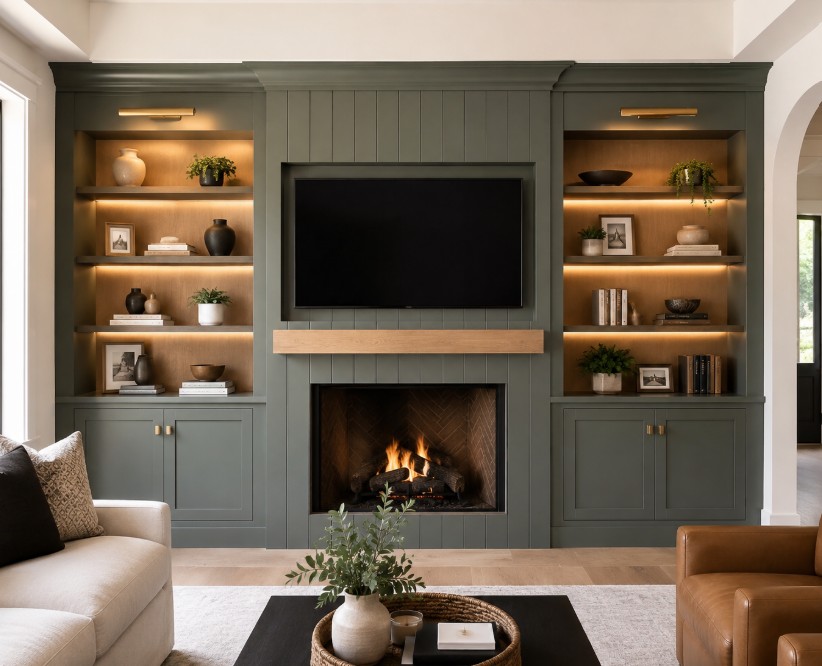
A media wall around a fireplace has to respect the manufacturer's clearance to combustibles, which rarely lines up with stock cabinet widths. Soffits, HVAC returns, window casings, and in-wall or behind-the-fabric speakers all need cabinetry built around them, and speaker doors need acoustically transparent grille cloth and IR-friendly panels. That is custom territory. Our entertainment center planning guide covers screen height and the fireplace question in detail.
Repairability
A chipped melamine edge or a swollen particleboard corner cannot be sanded and refinished; the part gets replaced, and finishes and colors get discontinued. A painted or stained plywood and hardwood build can be touched up or refinished in place for decades. The NAHB's life expectancy study put kitchen cabinets at up to 50 years, but that figure assumes quality construction and maintenance, not a specific material.
Where Custom Earns Its Price
Custom is not better in the abstract. It is better when the room asks for something stock cabinets cannot do. In a media room, that usually means:
- • Exact fit. Scribed to an out-of-plumb wall and an out-of-level floor, full height to the ceiling, with the shelf lines aligned to the window and mantel.
- • Equipment engineering. Deep vented bays, a rack or pull-out shelf for the receiver, a cable chase to the TV, a dedicated circuit, and access panels so you can service it later.
- • Material choice. Hardwood plywood carcasses, solid hardwood edges, and sprayed finishes in any color or species, including stain-grade white oak or walnut.
- • Integration. Fireplace surrounds, in-wall speakers, acoustic slat panels, projector screens, motorized TV lifts, and dimmable integrated lighting built into the casework rather than added to it.
- • Matching the house. Face frames, inset doors, and crown profiles that match existing trim, which matters most in older DMV homes where the goal is to look like it was always there.
The honest caveat: a custom quote is only as good as the shop. Ask in writing what the carcass is made of, how it is finished (shop-sprayed or brushed on site), what the shelf spans and thicknesses are, and what the warranty covers. If the answers are vague, the premium may not buy you anything over IKEA.
The IKEA Hack: An Honest Look
IKEA boxes plus custom fronts plus professional trim-out is a popular middle path, and it can look excellent. Here is what it does and does not change:
- • It fixes the look. A built toe kick, scribed fillers, finished end panels, crown, and quality fronts make IKEA boxes read as built-ins from across the room.
- • It does not change the box. The carcass is still particleboard at IKEA depths and sizes, with the same load and moisture characteristics.
- • It complicates the warranty. IKEA's warranty covers IKEA parts. Third-party fronts carry their maker's warranty, and modifications such as cutting a box down can void coverage on that part.
- • It narrows the savings. Fronts, panels, trim, paint, and skilled labor are the expensive part of any built-in, and the hack still needs all of them. Expect a finished IKEA built-in to cost roughly half to two-thirds of paint-grade custom, not a fifth.
Where the hack makes the most sense: a square wall, modest equipment, a dry above-grade room, and a homeowner who wants the built-in look now on a budget. The same logic applies to our small-space condo renovations, where stock boxes and custom fronts often hit the right balance.
Side-by-Side Comparison
| Factor | IKEA BESTÅ | IKEA built-in hack | Full custom |
|---|---|---|---|
| Carcass | Particleboard, fiberboard back | Melamine-faced particleboard | Typically hardwood plywood (specify it) |
| Depth | 15 3/4 in. standard frames | Fixed by the box chosen | Any; 18–24 in. equipment bays common |
| Fit to wall | Gaps at ends and ceiling | Fillers and scribe close most gaps | Built and scribed to the wall |
| Shelf load | 44 lb per surface (IKEA) | Same as the box | Engineered to the load |
| Water tolerance | Poor once edges get wet | Poor once edges get wet | Plywood recovers far better |
| Warranty | 10-year limited | IKEA parts only; fronts vary | Varies by shop; get it in writing |
| Lead time | Days | 2–6 weeks (fronts drive it) | 6–12 weeks design to install |
| Moves with you | Yes | No | No |
IKEA specifications are from IKEA US product pages and warranty documents at the time of writing; confirm on the page for the exact item you buy. Lead times are typical DMV ranges and vary with season and scope.
Custom vs. IKEA Media Cabinet Costs in the DMV in 2026
| Option | Estimated 2026 Cost per Linear Foot* |
|---|---|
| IKEA BESTÅ as furniture, DIY assembly and anchoringProduct only. Low TV benches at the bottom of the range, full-height units with doors and drawers at the top. | $50 – $250 |
| IKEA built-in hack, professionally trimmed and paintedIKEA boxes with toe kick, fillers, scribe, end panels, crown, and paint. Add more for third-party custom fronts. | $150 – $300 |
| Semi-custom cabinet line, professionally installedManufactured boxes in 3 inch increments with modified depths, often KCMA certified, plus trim-out. | $300 – $550 |
| Full custom, paint-grade (plywood carcass, MDF panels)Built and scribed to the wall, sprayed finish, vented equipment bays, adjustable shelving. | $350 – $750 |
| Full custom, stain-grade white oak or walnutReal wood veneer and solid hardwood. The top of the range is sequence-matched rift oak or walnut. | $600 – $1,900 |
*These figures are rough planning estimates only. Your actual quote will depend on in-home measurements and the current cost of materials and labor at the time of your project, as well as the specific finishes and scope you choose. For an accurate price, schedule a free in-home consultation with our team.
Tip-Over, Air Quality, and Certification
Anchoring is not optional, on either option
The U.S. Consumer Product Safety Commission reports that nearly 80 percent of furniture, TV, and appliance tip-over deaths involve children 5 and younger. IKEA's own BESTÅ listing says the product is a tipping hazard that must be anchored. What surprises most homeowners is that the mandatory federal stability rule adopted under the STURDY Act (16 CFR part 1261) covers dressers and other clothing storage units, and explicitly does not cover entertainment furniture, shelving units, or built-ins. There is no federal stability test standing behind a media console. The wall anchor, into studs or with hardware rated for your wall, is the protection, and the TV itself needs its own anchor or a properly rated mount.
Built-in custom cabinetry is fastened to the framing by design, which removes the tip-over risk of the cabinet itself. That is a genuine safety advantage of built-ins in a house with young children, though a correctly anchored IKEA unit is also safe.
Formaldehyde: the same rules apply to both
You will sometimes hear that IKEA is worse for indoor air than custom. The federal rule does not support that blanket claim. EPA's TSCA Title VI standard sets formaldehyde emission limits for hardwood plywood, MDF, and particleboard, including when they are inside finished products like cabinets, and requires third-party certification and labeling. IKEA and a local custom shop are held to the same limits. If you want to go beyond the legal minimum, ask any supplier for NAUF panels and a low-VOC finish. Our sustainable design guide explains which labels are meaningful.
Third-party performance testing
The Kitchen Cabinet Manufacturers Association runs the ANSI/KCMA A161.1 certification, where an independent lab tests a cabinet line for structural strength, door and drawer operation, and finish durability. Many semi-custom lines carry it. Small custom shops generally do not, because they build one-offs rather than certifiable product lines. That does not make custom weaker, but it means your protection with a custom shop is the written specification and warranty, not a seal. Ask for both.
Basement Media Rooms: The Moisture Question
A large share of DMV media rooms are in finished basements, and this is where the material difference matters most. Wood products take on and release moisture with the room's relative humidity. Particleboard and MDF that get wet swell in thickness and do not fully recover; plywood tolerates wetting and drying far better. That is the practical reason we specify plywood for below-grade cabinets.
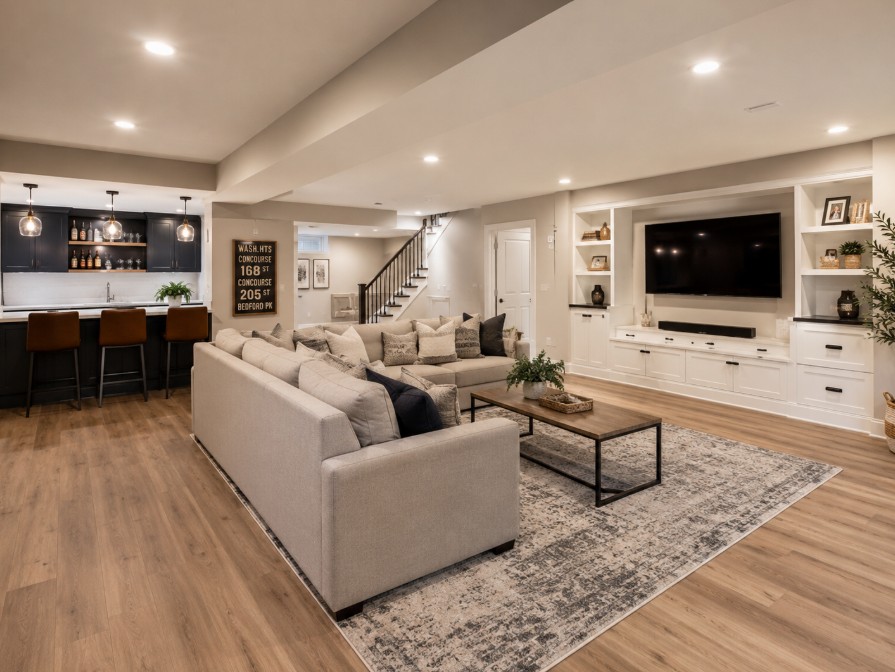
If you do use IKEA in a basement, protect it: legs or a sealed toe kick to keep the box off the slab, a gap and a finished back at the foundation wall, and a dehumidifier holding the room at 40 to 50 percent relative humidity. If the basement has ever taken on water, or has a sump that has ever failed, choose a plywood carcass. Our basement remodeling team addresses moisture at the wall and slab before any cabinetry goes in.
How to Decide for Your Room
Choose IKEA BESTÅ if
- • You rent or may move within 5 years
- • Equipment is a streamer, console, soundbar
- • The room is above grade and dry
- • You want furniture, not a built-in
Choose an IKEA hack or semi-custom if
- • You want the built-in look on a budget
- • The wall is reasonably square
- • Dimensions land near module sizes
- • Shelf loads are moderate
Choose full custom if
- • A fireplace, soffit, or window is involved
- • You run a full-size AV receiver or rack
- • The room is a basement with any water history
- • It should match the house's trim and read as original
If the media wall is part of a larger open living space, decide it with the rest of the room, because the cabinetry sets the sight lines and the zones. Our open concept planning guide and color palette guide help with both, and our interior design services can plan the whole room.
Mistakes We See Most Often
- • Buying BESTÅ before checking the AV receiver's depth and ventilation clearances
- • Leaving a tall media unit or the TV unanchored because it “feels heavy enough”
- • Putting particleboard directly on a basement slab with no toe kick or legs
- • Loading a 44 lb-rated shelf with components and a center channel, then living with the sag
- • Pricing an IKEA hack on box cost alone and forgetting fronts, trim, paint, and labor
- • Paying a custom premium without getting the carcass material in writing
- • Closing the equipment bay with solid doors and no exhaust path
- • Designing a media wall around stock widths instead of the room's actual sight lines
- • Cutting IKEA boxes down to fit and voiding the warranty on those parts
Compare them in person
Our North Bethesda showroom has custom door styles, species and paint samples, edge profiles, and shelf lighting you can see in real light. If IKEA is the right answer for your room, we will say so at the consultation. Plan a showroom visit.
Frequently Asked Questions
Are IKEA cabinets good enough for an entertainment center?
For many rooms, yes. IKEA BESTÅ and SEKTION boxes are consistently made, come with long written warranties (25 years on SEKTION in the US; 10 years on BESTÅ, with terms that vary by country), and cost a fraction of custom millwork. They fall short when the wall is out of square, the ceiling or alcove dimensions do not land on IKEA module sizes, the room is a damp basement, the shelves need to carry heavy equipment, or you need deeper cabinets for a full-size AV receiver. Those are the specific cases where custom earns its price.
What is the difference between IKEA BESTÅ and SEKTION for a media wall?
BESTÅ is IKEA’s living room storage system: 15 3/4 inch deep particleboard frames in fixed widths and heights, designed to sit on legs or hang on the wall as furniture. SEKTION is the US kitchen cabinet system: a 3/4 inch melamine-faced particleboard box built like a kitchen cabinet, which is why carpenters prefer it for built-in hacks with a toe kick, scribe fillers, and crown. SEKTION carries the longer 25-year warranty; BESTÅ carries 10 years.
Is an IKEA built-in hack cheaper than custom cabinets?
Cheaper, but not by as much as most people expect once it is professionally installed. The boxes are inexpensive; the fillers, scribing, toe kick, crown, painted end panels, third-party fronts, and installation labor are not. A professionally finished IKEA built-in typically lands around $150 to $300 per linear foot in the DMV, while paint-grade custom millwork starts around $350. The gap is real, and for a rental or a five-year house it is often the right call.
Can IKEA cabinets go in a basement media room?
Above a dry, dehumidified slab, yes, with precautions: keep the cabinet bottoms off the floor on legs or a sealed toe kick, keep a gap at the foundation wall, and hold the room between 40 and 50 percent relative humidity. Particleboard swells permanently if it gets wet, so if the basement has ever had water, a plywood carcass is the safer choice.
How deep should media cabinets be for AV equipment?
Most full-size AV receivers need about 20 inches of depth once you add rear connectors, cable bend radius, and airflow. Standard BESTÅ frames are 15 3/4 inches deep, which works for streaming boxes, game consoles, and compact amplifiers but is tight or too shallow for many receivers. Custom base cabinets are usually built 18 to 24 inches deep with an open or vented back in the equipment bay.
Do custom built-ins add more resale value than IKEA?
Honestly, neither reliably adds appraised value on its own. Appraisers price square footage, condition, and comparable sales, not millwork line items. What custom does is fit the house: a built-in that reads as original architecture helps a listing photograph and show well, while freestanding furniture leaves with you. If you plan to move within a few years, that argument is weak.
Do I need to anchor an entertainment center to the wall?
Yes. Anchor every tall cabinet and every TV, whether IKEA or custom. IKEA labels BESTÅ as a tipping hazard that must be anchored, and the CPSC reports that nearly 80 percent of furniture, TV, and appliance tip-over deaths involve children 5 and under. The federal STURDY Act stability standard covers dressers, not entertainment furniture, so the anchor is your protection.
Are IKEA cabinets safe for indoor air quality?
They are subject to the same federal formaldehyde limits as any other cabinet sold in the United States. EPA TSCA Title VI applies to hardwood plywood, MDF, and particleboard, including in finished products. A custom shop is held to the same rule, so compliance is not a differentiator. If air quality matters to you, ask any supplier, IKEA or custom, for NAUF (no added urea formaldehyde) panels.
Related Reading
Our best wood for a media wall guide covers plywood vs. MDF, species, and shelf spans; our custom entertainment center guide covers TV height, wall types, and permits; and our custom cabinets, cabinet refacing, and custom carpentry pages cover casework across the rest of the house.
Sources
- • IKEA US — SEKTION Kitchen Limited Warranty (March 2026) — the 25-year limited warranty on SEKTION frames, doors, drawer fronts, hinges, and drawers, limited to residential use, with knobs and handles excluded.
- • IKEA — BESTÅ 10-Year Limited Warranty brochure — the 10-year limited warranty on the BESTÅ storage system for domestic use, for the original purchaser with proof of purchase. Terms vary by country; check your local version.
- • IKEA US — BESTÅ frame product page — the 15 3/4 inch frame depth, particleboard and fiberboard construction, the 44 lb maximum load per horizontal surface, and the tipping-hazard anchoring requirement.
- • U.S. Consumer Product Safety Commission — Anchor It! tip-over statistics — nearly 80 percent of furniture, TV, and appliance tip-over fatalities involve children 5 and younger.
- • CPSC — Clothing Storage Units business guidance (16 CFR part 1261, STURDY Act) — the mandatory federal stability standard covers dressers and other clothing storage units. Shelving units, entertainment furniture, and built-in units are outside its scope.
- • U.S. EPA — Consumer FAQ, Formaldehyde Standards for Composite Wood Products (TSCA Title VI) — hardwood plywood, MDF, and particleboard, including those in finished goods, must meet federal emission limits and carry TSCA Title VI compliance labeling.
- • Kitchen Cabinet Manufacturers Association — ANSI/KCMA A161.1 certification — the independent lab test program for structural integrity, door and drawer operation, and finish durability that many semi-custom lines carry.
- • USDA Forest Products Laboratory — Wood Handbook (FPL-GTR-282, 2021) — Chapter 11 covers wood-based composite panels, including particleboard and fiberboard, and how their properties differ from plywood and solid wood.
- • USDA Forest Products Laboratory — Wood Handbook, Chapter 4: Moisture Relations — how wood and wood products gain and lose moisture with relative humidity, which is behind the basement guidance.
Additional reference: the National Association of Home Builders' Study of Life Expectancy of Home Components (2007), which estimates kitchen cabinets last up to 50 years. Product terms, prices, and warranties change; confirm current details with the manufacturer.
Not sure which option fits your room?
Book a free in-home consultation. We measure the wall, check its plumb and what is behind it, look at your equipment, and tell you honestly whether IKEA, semi-custom, or custom is the right call, with an itemized quote that names the carcass material. Related services: entertainment centers, basement remodeling, and custom cabinets.
Request your free consultation